
Venezuela loyalists to rally one week after Maduro's capture
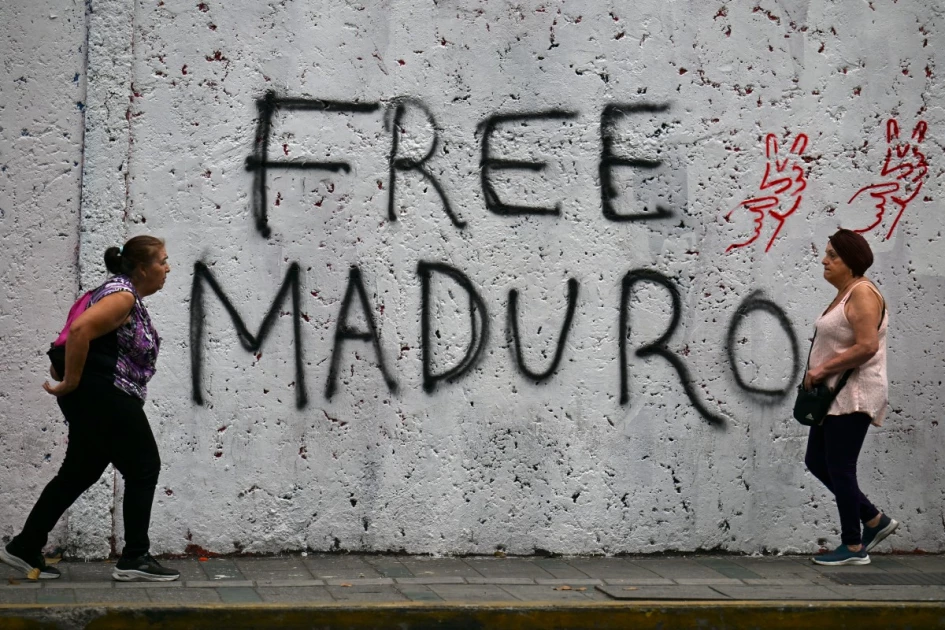
Women walk past a graffiti demanding the release of deposed Venezuelan president Nicolas Maduro and his wife Cilia Flores, snatched and taken to New York on January 3 to face trial on drug and weapons charges, in Caracas on January 10, 2026.

Audio By Vocalize
Supporters of Venezuela's deposed leader, Nicolas Maduro, geared up for a mass protest Saturday to mark one week since his dramatic
capture by US forces.
Anxious relatives meanwhile camped outside jails, awaiting
the promised release of political prisoners by the interim government.
Despite the shock of Maduro's capture during deadly
nighttime raids on January 3, signs emerged Friday of cooperation with
Washington after US President Donald Trump's claim to be "in charge"
of the South American country.
Venezuela's foreign minister said Friday it had launched
talks with the United States on restoring diplomatic ties, which were severed
in 2019 during Trump's first term.
Washington said US officials had visited Caracas to discuss
reopening the American embassy.
Interim president Delcy Rodriguez pledged to cooperate with
Trump over his demands for access to Venezuela's huge oil reserves after
Maduro's ouster.
But she also moved to placate the powerful pro-Maduro base
by insisting Venezuela is not "subordinate" to Washington.
In a gesture of ongoing defiance, organisers scheduled a
rally of activists from the ruling leftist "Chavista" movement for
1700 GMT on Saturday.
The demo caps a week of angry protests after the United
States launched airstrikes on Caracas and seized Maduro and took him to New
York to face trial on drug-trafficking charges alongside his wife, Cilia
Flores.
Rodriguez's camp on Thursday began releasing prisoners
jailed under Maduro, promising a "large" number would be freed in a
gesture of appeasement pending talks with Washington.
However, the prisoners' rights group Foro Penal said on
Saturday morning that so far only 11 had been freed, including several
prominent opposition figures.
Families slept out overnight under blankets near El Rodeo
prison east of Caracas, hoping for the release of their loved ones.
"I am tired and angry," Nebraska Rivas, 57, told
AFP, as she waited for the release of her son.
"But I have faith that they will hand him over to us
soon," she said, after sleeping out on the pavement for two nights.
"I have been fighting for this for seven years and I
feel encouraged now because this is the home stretch. But I am also
disappointed because nothing is happening."
Trump told Fox News he would meet next week with Venezuelan
opposition leader Maria Corina Machado, whom he earlier dismissed as lacking
the "respect" to lead Venezuela.
But he has made clear his intention to deal instead with
Rodriguez's government for the time being -- despite its loyalty to Maduro --
in the hope of accessing tens of millions of barrels of crude oil.
Trump said earlier Friday that he had called off a second
wave of attacks on Venezuela due in part to the release of political prisoners.
The US president had suggested he might use force again to
get his way in Venezuela, which has the world's largest proven oil reserves.
At a White House meeting on Friday, he pressed top oil
executives to invest in Venezuela's reserves, but was met with a cautious
reception.
ExxonMobil chief executive Darren Woods dismissed the
country as "uninvestable" without sweeping reforms.
Experts say Venezuela's oil infrastructure is creaky after
years of mismanagement and sanctions.
Trump said foreign firms had enjoyed no meaningful
protections under Maduro, "but now you have total security. It's a whole
different Venezuela."
He also stressed that the companies would deal only with
Washington, not Caracas, when exploiting Venezuela's oil resources.
Washington has maintained maritime pressure on oil tankers
in the Caribbean, where it seized a fifth tanker carrying Venezuelan crude on
Friday -- oil that would be sold, Trump said.
State-owned oil company PDVSA confirmed in a statement that
one vessel was returning to Venezuelan waters, describing it as the "first
successful joint operation" with Washington.
Leave a Comment