
What is really driving Kenya's crisis of student unrest?
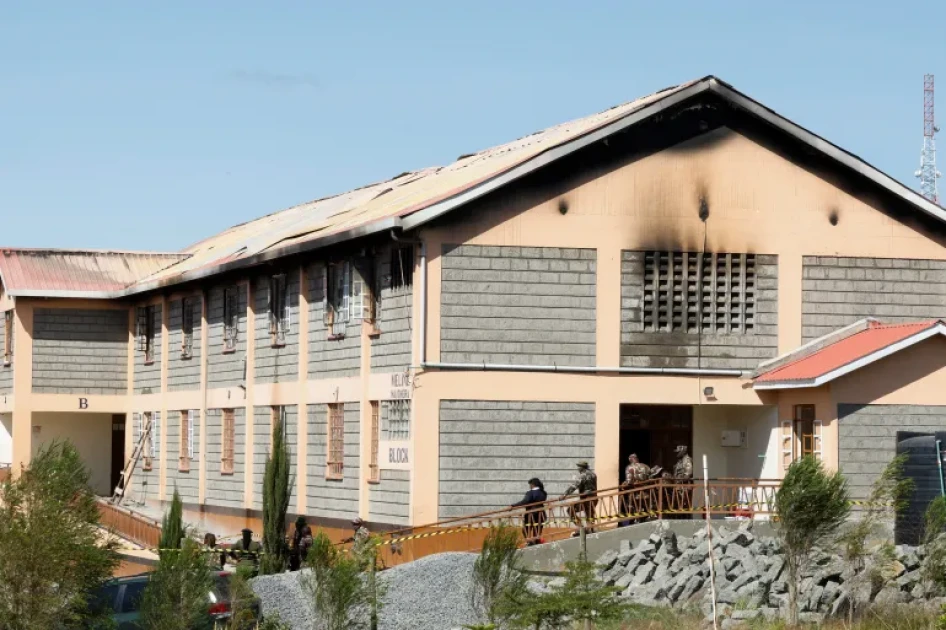
Security officers stand outside a burnt dormitory at the Utumishi Girls' Academy Senior School following an overnight fire at the facility in Gilgil, Nakuru county, Kenya May 28, 2026 [Monicah Mwangi/Reuters]

Audio By Vocalize
Fires have spread. Dormitories have been torched. Hundreds of students across multiple counties have been sent home.
Nationally recognized schools, institutions long regarded as the gold standard of Kenyan secondary education, have been shuttered indefinitely.
The question on the lips of parents, teachers, lawmakers, and psychologists is no longer simply why did Utumishi happen? It has become: what has gone so profoundly wrong inside Kenya's schools?
And, uncomfortably: whose fault is it?
How It Began, and How Fast It Spread
The Utumishi fire was not an accident. Investigations by the Directorate of Criminal Investigations quickly confirmed the blaze was arson.
Nine students were arrested within days. A court in Naivasha on June 3 remanded nine suspects, all girls, to a children's home for 21 days while detectives gathered evidence.
Police established the precise mechanics of the attack: a mattress at the dormitory exit was set alight with a matchstick and paraffin in the early hours of the morning.
The emergency door, critically, was found to have been locked, trapping students who had fled toward it. Sixteen were burnt beyond recognition near that exit.
What drove the arsonists? The suspects' statements, once they began to talk, were strikingly mundane. Reports indicate the school administration had moved examination dates forward, from June 16 to June 2, angering Form Four students already under enormous pressure.
There was also palpable unease over mandatory contributions to a cultural event. On the other hand, peer pressure played a role: a strike at a neighboring boys' school, it emerged, had emboldened some students to act. These grievances, banal in isolation, cost sixteen lives.
In the weeks that followed, the contagion was swift. The Kenya Red Cross confirmed it had responded to 37 school fire incidents across multiple counties since the start of 2026 alone, with Utumishi representing the deadliest. In Kiambu County, a fire at the iconic Alliance High School on June 4, gutted a storage facility; 11 students were detained over a suspected coordinated strike, with preliminary investigations revealing some had been in contact with students from other schools to plan simultaneous unrest.
In Makueni County, five schools were closed indefinitely, with students at Kavuthu, Kyamuthei, Nguumo, and Kalama secondary schools setting dormitories alight and students at Kaumoni Boys High School burning the administration block and classrooms.
Loreto High School, in Limuru, Lenana School, Naivasha Girls High School, Moi Girls Nairobi, Sironga Girls National School in Nyamira, Kisii School, Kakamega School, Chianda High School in Siaya, and State House Girls High School in Nairobi were among the scores of institutions affected by closures, fires, or precautionary student releases.
By June 5, schools across Nairobi, the Rift Valley, Western Kenya, Nyanza, and parts of the Mt Kenya region had sent students home, not because of a government directive, but out of sheer fear of what the night might bring.
The immediate-former Basic Education Principal Secretary Julius Bitok, who has since been transferred to a tourism ministry, while speaking at a prize-giving ceremony at The Kenya High School that same week, insisted that only about 80 of Kenya's nearly 9,500 schools had experienced unrest, and that the academic calendar would not be altered.
Critics regarded this framing as a studied minimisation of a crisis already out of hand, a case of the ostrich hiding its head in the sand and hoping the crisis it cannot see is therefore small and of no consequence.
What Lies at the Heart of the Student Unrest?
The student unrest convulsing Kenyan schools in 2026 is not new. But it has accelerated, widened, and turned deadlier. Education experts warn it cannot be explained by any single cause.
Exam pressure and the calendar trap
The most immediate trigger in school after school has been examination anxiety. Second term in Kenya's secondary school calendar is when mock KCSE examinations are administered, a critical rehearsal for the national examinations that will determine a student's future.
The stakes are existential for many Form Four students, who have spent years building toward this moment. When administrations move exam dates forward without notice, or tighten academic schedules without corresponding pastoral support, the pressure cooker effect intensifies.
Kiharu MP Ndindi Nyoro has publicly called on the Ministry of Education to review the second-term calendar, arguing that prolonged school sessions were placing excessive pressure on learners in boarding schools. He proposed additional mid-term breaks and more visiting days. The Ministry, thus far, has refused to budge.
In a press address on Wednesday, Education Cabinet Secretary Julius Ogamba said the school calendar would be rationalised starting next year to ensure the three terms are balanced.
Poor living conditions and unheard grievances
Overcrowding is pervasive. At Utumishi itself, a dormitory designed for far fewer students was housing approximately 220 pupils.
The Kenya Union of Post Primary Education Teachers (KUPPET) has pointed to infrastructure that has simply failed to keep pace with rising student numbers, a problem compounded by the ongoing transition to senior school under the Competency Based Curriculum (CBC), which has funneled more students into institutions lacking sufficient facilities and oversight to absorb them.
In school after school, students have cited the same grievances: insufficient food, poor dormitory conditions, and the sense that complaints go nowhere.
State House Girls High School, one of Kenya's most prestigious, was closed following planned student protests over food supply and living conditions.
The pattern is consistent: students feel unheard, pressure accumulates, and when the moment of rupture comes, fire is the language they reach for.
The social media accelerant
Previous waves of school unrest spread through word of mouth; currently, they spread instantaneously. Kenya Secondary Schools Heads Association (KESSHA) chairman Willie Kuria, principal of Murang'a High School, put it plainly: students with access to laptops and digital platforms communicate easily and influence one another.
What begins as localized grievance at one school is amplified, glamourized, and replicated across county lines within hours. Investigators have confirmed that students in the Alliance High School fire were in contact with peers at other schools when planning the unrest. Security agencies have warned that social media is being used to coordinate simultaneous walkouts and arson attacks.
The counselling vacuum
Kenya's schools are critically short of professional counselling capacity. In most boarding institutions, counselling is a secondary duty assigned to a teacher already stretched across lessons, administrative duties, and dormitory supervision.
There is no dedicated professional whose sole function is the psychological wellbeing of hundreds of adolescents navigating puberty, family instability, academic pressure, and the peculiar psychological pressures of months-long separation from home.
It is increasingly being demanded by education experts that every boarding school must have a trained counsellor on staff, and not just a teacher doubling up between lessons to counsel students. As it stands, that is a rarity.
Drug abuse
Experts have for years flagged drug abuse as an accelerant of school indiscipline. From alcohol, to marijuana, injectable and snorted drugs and even vapes, substances compromise judgment, lower inhibitions, and amplify impulsive responses to perceived injustice.
The Ministry of Education has itself acknowledged drug abuse as a contributing factor to school fires and unrest. In the current crisis, educators have urged parents to stop treating this as a school problem alone.
Who Is to Blame?
The honest answer is: everyone among the stakeholders, albeit in different measure.
The Government
The government's culpability is structural and historical. For decades, it has produced safety manuals, task forces, and circulars, then failed to enforce them.
The 2008 Safety Standards Manual, which prohibits locking emergency exits from outside when students are inside, was flagrantly violated at Utumishi Academy on the night of the fire.
Education CS Julius Ogamba himself acknowledged that two teachers at the school had been informed of the students' arson plans beforehand and failed to act. He also confirmed the school's emergency exit was locked during the fire.
The 2024 Ministry of Education safety assessment had identified 348 schools for closure over non-compliance. They remain non-priority to the government.
Beyond physical safety, the government has underfunded the guidance and counselling infrastructure that might interrupt the cycle before it reaches ignition point.
It has repeatedly resisted examining the academic calendar's contribution to student mental health crises. And the Ministry's current insistence that the second-term calendar will not change, even as schools burn across the country, signals a government more invested in appearances than in addressing the conditions producing the unrest.
School Administrators and Teachers
The most damning immediate finding to emerge from Utumishi is this: teachers knew. Whether through disbelief, fear of the administrative consequences of reporting, or sheer negligence, they failed to act on intelligence that might have saved sixteen lives.
More broadly, school administrators across Kenya have been complicit in overcrowding their dormitories beyond safe limits, failing to maintain emergency exits, and treating guidance and counselling as a box-ticking exercise rather than a genuine intervention system.
The institutional culture in many schools, hierarchical, punitive, and closed to student voice, creates the very pressure that eventually explodes.
Many students, education analysts note, lack safe, trusted channels through which to raise concerns. Suggestion boxes go unread. Direct engagement with administrators is discouraged. The grievance festers until it becomes a fire.
Parents
Parents bear a share of responsibility that has been consistently under-acknowledged in public debate.
The warning is now being stated openly by educators: parents have increasingly delegated the entirety of discipline and emotional formation to teachers, treating boarding school enrolment as a transfer of all parental responsibility until the holidays.
Students arrive in school with drug-addiction problems, entitlement, and unresolved emotional needs that teachers are neither trained nor resourced to address.
The reduced frequency of visiting days, a policy introduced to limit disruptions to learning has, in many cases, deepened the emotional estrangement between adolescents and their parents. Young people who cannot communicate distress to a parent, and who have no trusted counsellor at school, are left with no outlet at all.
The decision to use fire as the medium of that distress, however reprehensible, is symptomatic of a total failure of the channels through which young people are supposed to find relief.
Parents should strive to craft regular or daily customs that encourage responsibility, close meaningful family interaction, physical activities, spiritual engagement, community service and rest.
This can be done partly by volunteerism, household chores, teaching life-skills in different settings, and spending quality time with the children.
As parents, one thing, probably above all, is to learn to listen to the young people over their emotions, questions, fears, frustrations and dreams. Let parents create safe spaces for the young people.
The Students
The students who light the matches bear direct and serious responsibility for their actions. Nine suspects in the Utumishi fire are in custody facing potential charges for what amounted to a mass killing of their schoolmates.
That framing must not be softened. Arson in a dormitory at 1:00 a.m. is not a form of protest. It is lethal.
Yet the evidence from Utumishi Academy and from school fires stretching back to Kyanguli in 2001 is consistent: the students who start these fires typically do not intend to kill.
The 14-year-old convicted for the 2017 Moi Girls fire was found by the court to have wanted a school transfer, not to kill her classmates.
The Utumishi suspects wanted to push back against a rescheduled exam. What they did not calculate, or did not believe, was that the building's locked emergency exit would turn a protest into a massacre.
This does not mitigate guilt. But it does illuminate the failure of every adult institution, school, government, and family to provide any alternative to “fire.”
The Copycat Contagion
Security agencies and education experts have raised specific alarm about the copycat dimension of the current crisis. The 2017 National Crime Research Centre report flagged students communicating via smuggled phones to coordinate fires.
Today, the mechanism is more sophisticated and harder to detect: social media platforms, group chats, and coordinated messaging that can turn a local grievance into a national movement overnight.
KESSHA's Kuria noted that students are increasingly aware of what is happening at other schools in real time and that awareness, in the current climate, is spreading the contagion faster than any intervention can contain it.
The Ministry of Education's response has been to order tighter supervision, deploy additional school inspectors, and direct emergency Board of Management meetings. These are, at best, containment measures. They address the symptom rather than the cause.
What Needs to Happen?
The immediate crisis schools on fire, students in custody, parents in grief, all demand an urgent and comprehensive response.
But Kenya has had urgent responses before. What it has not had is comprehensive structural reform.
Professional counsellors, not deputized teachers, need to be embedded in every boarding school. The academic calendar, specifically the relentless pressure of second term, needs serious review.
The Safety Standards Manual needs enforcement mechanisms with real consequences: principals and board members who preside over dormitories with locked emergency exits should face criminal liability, not just administrative censure.
Dormitory overcrowding must be treated as the life-threatening condition it has proven to be. The Quality Assurance and Standards Directorate needs the funding to actually inspect, not merely document.
And parents must be drawn back into a meaningful, continuous relationship with their children's emotional lives, not handed a bill at the start of each term and absolved of further responsibility until the holidays.
Kenya has, across two decades and hundreds of funerals, accumulated more than enough evidence to understand what drives its students to burn their schools. What it has not yet found is the political will to do what the evidence demands.
As sixteen families in Nakuru County bury their daughters, that question remains unanswered. And secondly, the set-up in all the school unrest reported is within the boarding school set-up, is it not time also that Kenyans had a sincere conversation about the pros and cons of boarding schools?
Join the Discussion
Share your perspective with the Citizen Digital community.
No comments yet
This discussion is waiting for your voice. Be the first to share your thoughts!