
President Ruto signs 3 Bills into law
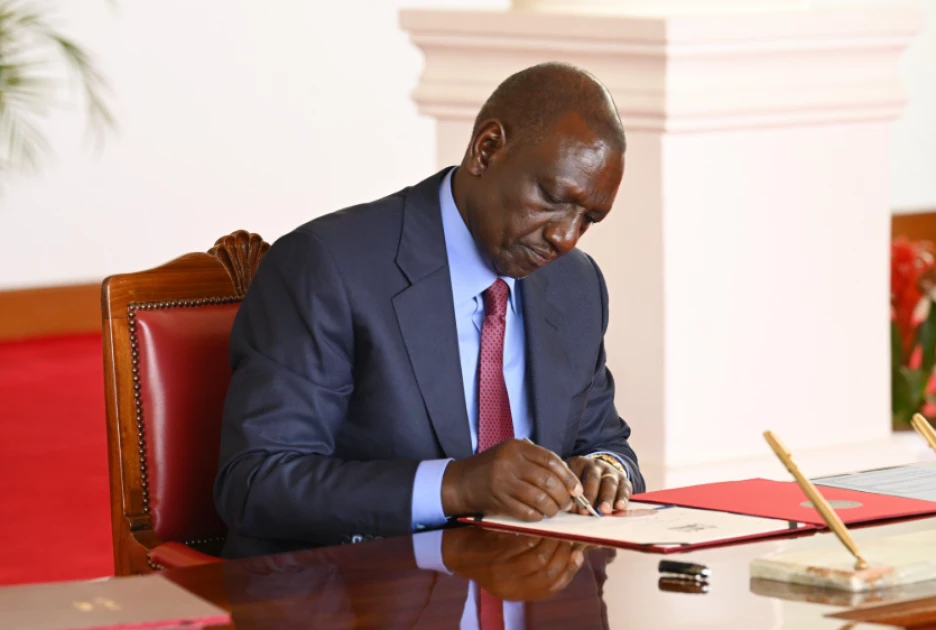
President William Ruto signs the County Allocation of Revenue Bill, 2024, at State House in Nairobi on December 6, 2024. PHOTO | PCS

Audio By Vocalize
The legislations are the Miscellaneous Fees and Levies (Amendment) Act, 2026, the Coffee Act, 2023 (Mediated Version), and the Meteorology Act, 2023.
The Coffee Act, 2023, provides for the development and regulation of the coffee industry in Kenya. It reorganises the coffee sector by transferring the regulatory and commercial roles currently undertaken by the Agriculture and Food Authority (AFA) to the Coffee Board of Kenya.
In the new law, the Coffee Board is mandated to regulate and promote the development of the coffee industry. Its functions include processing permits and licence applications, registering coffee dealers, and overseeing the implementation of strategies, policies, and funding models for the sector.
The board is also mandated to collect and maintain industry data, conduct market intelligence and surveys, promote Kenyan coffee in local and international markets, and support the application of the Kenya Coffee Mark of Origin.
In addition, the board will develop industry standards and codes of practice in collaboration with the Kenya Bureau of Standards.
The new Act gives the board the power to promote regional coffee appellations, facilitate technology transfer to county governments, build capacity among industry players, enforce compliance with relevant policies and standards, coordinate representation in international coffee forums, regulate coffee marketing and trading, and promote digital marketing to expand markets for Kenyan coffee.
In undertaking these functions, the board will collaborate with other licensing authorities and stakeholders in the industry, including county governments and the Capital Markets Authority.
The Act also transfers the coffee research role currently undertaken by the Coffee Research Institute to a newly established Coffee Research and Training Institute. The management of the institute will be vested in a council that includes a chairperson appointed by the relevant Cabinet Secretary.
The primary role of the institute is to advance research and training in the coffee sector. It will develop systems that promote sustainable and diversified coffee development and optimise production through research.
The institute will also coordinate research on coffee diseases and the development of new crop varieties.
Additionally, it will facilitate the adoption of improved production technologies within the coffee sector.
Meanwhile, the Miscellaneous Fees and Levies (Amendment) Act, 2026, amends Section 8 of the Miscellaneous Fees and Levies Act to expand the scope of the Railway Development Levy to support a broader range of railway transport infrastructure beyond the construction and operation of the Standard Gauge Railway.
The amended law supports the government’s policy objective of mobilising sustainable financing for strategic railway transport infrastructure while strengthening the institutional framework for the management and utilisation of the Railway Development Levy.
The amended Act establishes the Railway Development Levy Fund into which all funds collected from the Railway Development Levy will be paid.
The creation of the fund aims to ensure that the resources raised through the levy are properly managed and specifically utilised for the development of railway infrastructure.
Under the law, proceeds from the levy may also be used to support the safety and economic regulation of railway infrastructure, as well as the rehabilitation of existing railway systems.
The rehabilitation of railway transport infrastructure will require approval from both the Cabinet Secretary for the National Treasury and the Transport Cabinet Secretary.
The amended Act further establishes the Railway Development Fund Board, which will be responsible for the administration and management of the Railway Development Levy Fund.
The board will be a corporate body with the authority to sue and be sued, enter into contracts, and perform other functions necessary for the proper management of the fund.
The board's responsibilities will include the formulation of the fund's strategic direction, review and approval of programmes and budgets, overseeing the administration of the fund, and ensuring that resources are used efficiently.
On its part, the Meteorology Act, 2023, establishes a legislative framework to regulate meteorological services in Kenya and to coordinate and monitor their delivery.
The law also ensures that Kenya complies with international standards and obligations governing meteorological services under the Chicago Convention on International Civil Aviation and the Intergovernmental Oceanographic Commission of UNESCO.
The new law establishes the Kenya Meteorological Service Authority, which will serve as the principal technical adviser to both national and county governments on meteorological matters.
The Authority will be responsible for establishing and maintaining meteorological management systems for data processing, analysis, forecasting, and archiving.
It will also prepare and disseminate weather forecasts, issue advisories and warnings for disaster risk reduction through a variety of early warning systems, and develop curricula and training programmes in meteorology aligned with international standards.
In addition, the Authority will register weather stations for meteorological data collection and coordinate research and development in meteorology.
The new Act also establishes the Meteorology Training and Research Directorate as the successor to the Institute for Meteorological Training and Research.
The directorate will serve as the designated World Meteorological Organisation Regional Training Centre, offering certificates, diplomas, and professional courses in meteorology, operational hydrology, and related sciences.
The law further empowers the Authority to identify sites for meteorological observation stations and enter into agreements with landowners for the use of their property for observation purposes.
It also provides intellectual property protection for data, advisory services, inventions, discoveries, and innovations generated by the Authority.
In addition, the Act outlines offences that may interfere with the effective delivery of meteorological services.
Join the Discussion
Share your perspective with the Citizen Digital community.
No comments yet
This discussion is waiting for your voice. Be the first to share your thoughts!