
'Intended killings': Tanzania's election violence ensnared unsuspecting victims
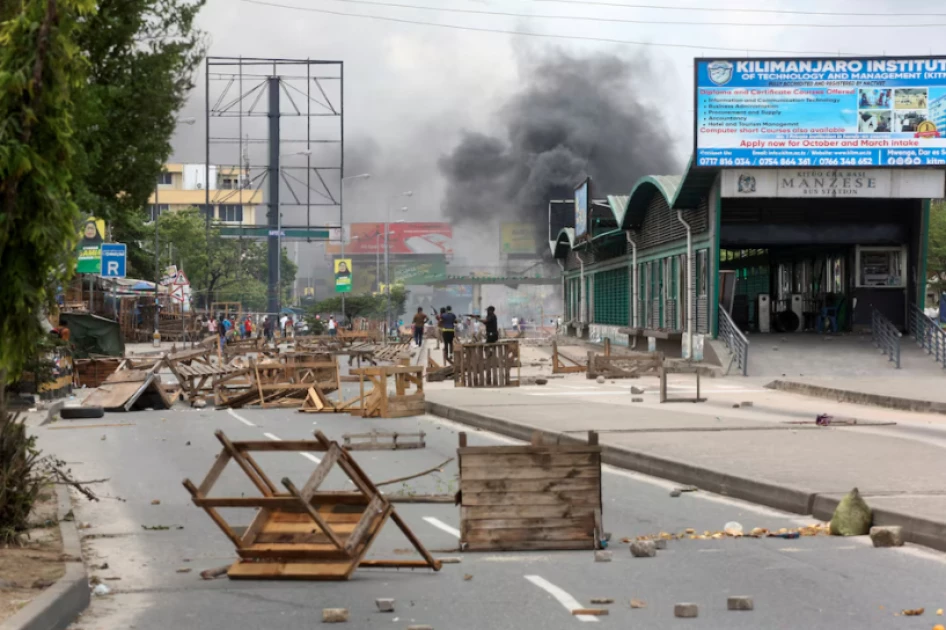
Tanzanian police disperse demonstrators during violent protests that marred the election following the disqualification of the two leading opposition candidates in Dar es Salaam, Tanzania, October 29, 2025. REUTERS/Onsase Ochando/File Photo

Audio By Vocalize
Around 8:30 p.m. on October 31, a group of policemen
appeared in the Mjimwema neighbourhood of the Tanzanian city of Mwanza, where
residents were running errands and drinking coffee. Without warning, they
opened fire in different directions, triggering panic.
The officers ordered men who had taken shelter in a nearby
cafe to lie on the ground and then shot at them, three witnesses told Reuters.
By the time shooting subsided, more than a dozen lay dead, they said.
A video posted on social media in early November and
verified by Reuters shows the aftermath - 13 limp bodies splayed on the
blood-soaked ground.
The massacre in Mjimwema, reported by Reuters in detail for
the first time, is one of the deadliest known incidents from days of violence
around Tanzania's October 29 elections.
Reuters interviewed nine witnesses to eight other incidents
in Mwanza as well as Tanzania's commercial capital Dar es Salaam and the
northern city of Arusha who said they saw officers shoot at people who were not
protesting, sometimes kilometres away from any known demonstrations.
Driven by the exclusion of leading opposition candidates
from the elections and a surge of arrests and alleged abductions of government
critics, the violence was the worst political unrest in Tanzania's
post-independence history and has undermined its reputation for stability.
The U.N. human rights office estimates hundreds were
killed and the U.S. government says it is reviewing its relationship with
the country, partly as a result.
The demands by mostly youthful demonstrators for more
accountable governance echoed so-called Gen-Z protests in countries like Kenya, Madagascar and Nepal,
which have forced major reforms or toppled governments.
Charles Kitima, the secretary-general of the Tanzania
Episcopal Conference, the country's Catholic bishops organisation, said police
deliberately targeted civilians.
"We have witnessed lots of people killed in their
houses. That's why we say it was intended killings," Kitima told Reuters.
He acknowledged some looting occurred: "But overall
protesters were not criminals. They were demonstrating their needs."
Palamagamba Kabudi, a senior Tanzanian official, said the
government takes concerns about the use of force seriously and has created
a commission of inquiry to investigate election violence. However, he
said many allegations were based on unverified and out-of-context information.
"The Government does not recognise a policy or practice
of intentional brutality against civilians," Kabudi, Minister of State in
the President's Office, told Reuters in written responses to questions.
"Security operations are conducted for specific
law-enforcement purposes and are governed by legal safeguards."
President Samia Suluhu Hassan was declared winner of the
presidential election with nearly 98% of the vote. In public remarks, she has
defended the security response as a reasonable reaction to violence by
protesters.
Hassan, previously vice president, came to power in 2021
when her predecessor died in office and the vote was her first electoral test.
After initially promoting democratic reforms, Hassan has in recent years clamped
down on opponents her government accuses of trying to disrupt elections
and foment instability.
After young people in several cities took to the streets on
election day, authorities cut internet access across Tanzania for more than five
days, limiting access to information and reliable accounts of violence.
Shortly before the connection was restored, police
threatened legal action against anyone who shared images that "cause
panic or degrade a person's dignity".
Independent human rights experts appointed by the U.N. Human
Rights Council said in December that “disturbing reports” indicated security
personnel were given "shoot to kill" orders during an enforced
curfew, without saying where that information came from.
Kabudi said the government "categorically rejects
claims that 'shoot to kill' orders were issued as policy".
The U.N.-appointed experts estimated at least 700 people had
been extrajudicially killed but said other estimates pointed to thousands of
potential victims.
Kabudi acknowledged that lives were lost but said it would
be premature to issue a definitive death toll. The commission of inquiry's
findings would be published "in due course", he said.
WITNESSES DESCRIBE
KILLINGS FAR FROM PROTESTS
Witnesses interviewed by Reuters from Mwanza, Dar es Salaam
and Arusha, Tanzania's three biggest cities, described widespread vandalism
during protests, saying some demonstrators set fire to government offices,
properties belonging to ruling party members and public infrastructure.
But, according to the witnesses, police shot civilians not
involved in demonstrations and fired indiscriminately into crowds of
protesters.
In most cases, the witnesses said they did not know why the
police acted the way they did. In some, officers appeared to be targeting
civilians accused of ignoring orders the officers had issued to go home, they
said.
Reuters was unable to ascertain the legal basis for these
orders.
While the police announced on state television a
dusk-to-dawn curfew in Dar es Salaam after the initial violence, Reuters could
find no evidence of an official curfew or lockdown order for Mwanza or anywhere
else.
The national police spokesperson did not respond to a
request for comment.
POLICE SHOT CAFE
PATRONS
From the hills above Lake Victoria, people in Mjimwema could
see demonstrations elsewhere in Mwanza on October 30 and 31, but there was no
unrest in the immediate area, six residents told Reuters in telephone
interviews.
Nonetheless, at around 6 p.m., police came through the
neighbourhood to order people who were shopping or watching television in cafes
to go home, an instruction that was largely ignored, a witness said.
Around two hours later, about half a dozen police officers -
some in the green police uniforms worn by many field units, others dressed in
black - arrived on foot and began firing their weapons in different directions,
four witnesses said.
Terrified people scattered. One of the witnesses hid in a
house. Another sheltered in a nearby bar.
In one cafe, a wooden structure that had no official name
but showed soccer matches, patrons switched off the television and the lights
in hopes of going unnoticed, said two witnesses who were inside. One of them
said he then snuck out a back door and sprinted to a nearby compound. The other
remained inside.
When the police reached the door, they ordered those inside
to come out and lie on the street, said three of the witnesses.
The witness still inside the cafe said he crawled out, as
instructed by the officers. He recalled a stream of insults from the police but
at no point did the officers explain their actions, he said.
Then the shooting started. For around 30 seconds, the
witness stayed still. "They would shoot again if they noticed you were
moving," he said.
After the police left, firing into the air as they departed,
he rose, shaken but alive. He said he saw over 15 dead and wounded people
around him.
A video posted on social media platform X by a U.S.-based
Tanzanian activist on November 5 showed 13 lifeless bodies, surrounded by pools
of blood, most face-down near the cafe's entrance. The ground is strewn with
sandals, a glass bottle and a cell phone.
A voice can be heard saying: "All of them are dead.
This is murder."
In a photo taken by a witness and verified by Reuters, nine
of the same bodies are visible.
Two of the witnesses – the one hiding in the bar and the one
who fled to a nearby compound – said they saw at least 14 bodies after the
shooting.
A few minutes later, police officers in green uniforms
pulled up in a large vehicle, loaded the bodies inside and drove off, according
to four witnesses, the fourth of whom had returned to the area after taking
shelter down the road.
A man in his 20s with a gunshot wound arrived at the nearby
Sekou Toure Hospital around 10 p.m., saying police shot people at a Mjimwema
cafe, said a person at the hospital that evening. Less than an hour later,
police brought about 15 young men - all but one were dead from bullet wounds,
he added.
Kabudi said authorities are reviewing the Mjimwema incident
but require verified information before drawing any conclusions.
SOME VICTIMS NEVER
FOUND
Thirty-nine-year-old Raphael Esau Magige and his 27-year-old
nephew Johnson Patrick Deus went to the cafe that evening to watch the
television news, a family member said.
Neither was politically active, the family member said.
Deus, who was learning to drive for a job he had landed in Dar es Salaam, had a
young son. Magige, a tailor, had a teenage daughter.
Family members identified their remains at the Sekou Toure
hospital mortuary. Deus had been shot four times, including in the ribs and the
chest, while Magige had been shot three times in his neck and chest, the family
member said. They were buried on November 4.
Another victim was 20-year-old Juma Shaban Joseph, a
domestic worker and fervent supporter of Dar es Salaam’s Simba S.C. soccer
club, a family friend told Reuters, citing witnesses who saw his body at the
scene.
Like the families of many victims nationwide, Joseph's
relatives have searched city hospitals and mortuaries in vain for his body, the
person said.
In their November statement, the U.N. Human Rights Office
cited “disturbing reports” that security forces had taken bodies to undisclosed
locations "in an apparent attempt to conceal evidence".
Kabudi denied there was a policy of concealing bodies or
evidence.
The cafe in Mjimwema is no longer standing, according to a
photo taken in mid-December. A few weeks after the incident, one of the
witnesses said he saw workers dismantling the structure. Reuters could not
determine who ordered this.
Leave a Comment