
Court recognises 'invalid' second wife's right to Inherit husband's estate
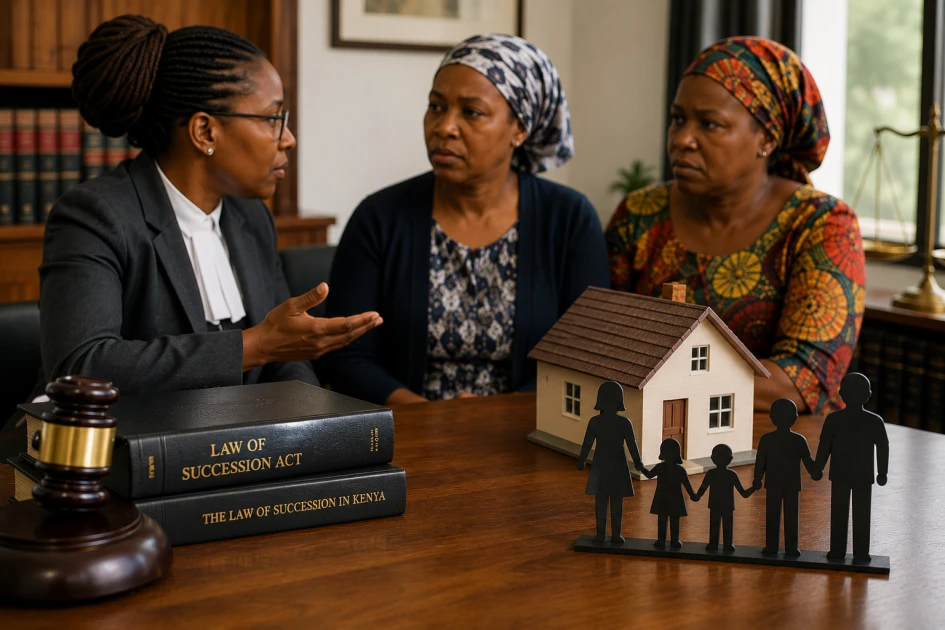
This image was created using artificial intelligence and is intended for illustrative purposes only. It does not depict the actual individuals, events, or location referenced in this story.

Audio By Vocalize
In a judgment delivered on July 2, Justice H.K. Chemitei held that Jane Jerry Kioko qualifies as a wife of the late Ndolo Kioko Musyimi for purposes of succession, and appointed her a joint administrator of his estate alongside his children.
The ruling turned on Section 3(5) of the Law of Succession Act, which the court said was enacted specifically to protect women and children who enter customary unions with men already in subsisting monogamous marriages, even where such subsequent marriages would ordinarily be considered void.
The dispute arose after the deceased's children petitioned for letters of administration following his death on December 30, 2021, identifying themselves as his beneficiaries. Jane objected, telling the court she was his wife and that the two had two children together.
Evidence showed the deceased had married his first wife, Loise Wambui Muigai, in 1987 in a monogamous union. Although divorce proceedings had reportedly been initiated, the marriage had not been legally dissolved when he went on to marry Jane under Hehe customary law in Tanzania in March 2015, later formalising the union through a civil ceremony that June.
Jane testified that the deceased had assured her he had already divorced his first wife before their marriage. Witnesses told the court that dowry was paid, customary rites were properly performed, and that the deceased openly introduced her as his wife. She also cared for him during his final illness and was recognised as his widow during his funeral.
The first wife opposed Jane's appointment as administrator, arguing that the second marriage was invalid since her own union with the deceased was still subsisting at the time, and that the estate largely comprised property the couple had acquired together during their marriage.
Justice Chemitei agreed that the second marriage was legally invalid and could technically amount to bigamy. However, he ruled that Parliament had deliberately crafted Section 3(5) to shield women in Jane's position, noting that the deceased had lived with her as husband and wife, publicly acknowledged her as his spouse, and fathered two children with her, satisfying the definition of a wife under succession law.
The judge added that questions over which specific assets form part of the estate, and whether some properties should be classified as matrimonial property belonging to the first marriage, would be resolved at the distribution stage.
The court allowed Jane's objection and appointed her joint administrator alongside the other administrators, directing them to apply for confirmation of the grant within 45 days. Costs were ordered to be in the cause.
Join the Discussion
Share your perspective with the Citizen Digital community.
No comments yet
This discussion is waiting for your voice. Be the first to share your thoughts!