
Venezuela earthquakes kill nearly 1,000, tens of thousands missing
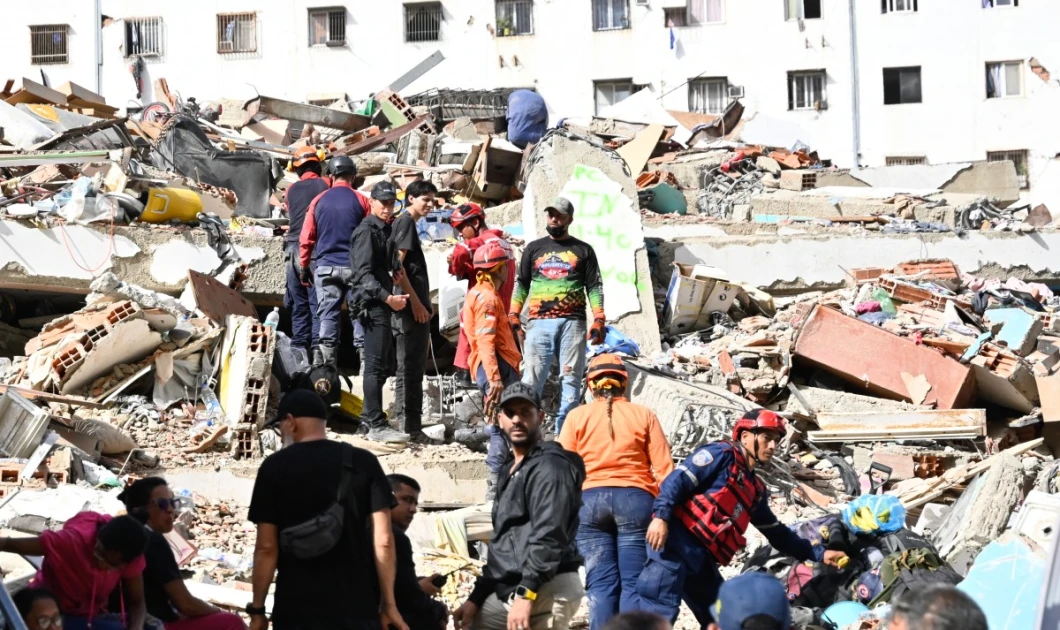
Venezuelan Civil Protection members, firefighters and volunteers work at the site of a collapsed building following earthquakes in Caraballeda, La Guaira state, Venezuela, on June 26, 2026. Photo by MARYORIN MENDEZ / AFP

Audio By Vocalize
The death toll from twin earthquakes in Venezuela rose
Friday to 920, with tens of thousands reported missing as international rescue
teams boosted a desperate and slow-moving search for survivors.
Caracas residents jeered interim leader Delcy Rodriguez
during her visit to a devastated neighbourhood, as fury over the perceived lack
of an official response mounted.
United Nations aid chief Tom Fletcher told AFP that more
than 50,000 people were missing after two powerful earthquakes struck within a
minute of each other on Wednesday evening, flattening buildings in the north of
the country.
The coastal area of La Guaira, near the capital Caracas, was
the worst hit, with one building after another crumpled by the magnitude 7.2
and 7.5 quakes.
Access to the disaster zone was restricted from 8:00 pm on
Friday (0000 GMT Saturday), Interior Minister Diosdado Cabello announced in a
televised address.
A rescue team from Chile arrived at one residential complex
in La Guaira, made up of four tall buildings housing hundreds of apartments that
had largely been reduced to rubble.
"Unfortunately, the collapse is total, and there is
little chance of finding survivors. Efforts are now focused on recovering the
bodies of the deceased," team leader Nadiomar Polanco said at the site,
which resembles many others in the city.
Elsewhere, family members, neighbours, and volunteers used
their bare hands to try to dig out survivors, bemoaning the lack of heavy
machinery or official help to save those trapped alive.
"I am looking for my little Gael... he was only five
months old," said an anguished Marjosly Salazar, 40, whose 16-year-old
daughter died in the quake. The baby and Salazar's cousin are both missing.
"Please, we need support here. We need machinery to
start lifting the columns," she said. "We haven't seen any government
officials here, none at all."
In an upscale Caracas neighbourhood, Rodriguez was greeted
with angry chants from a crowd of people whose loved ones were trapped under
the debris.
"The government isn't doing anything for the
people," they yelled from behind cordons next to a pulverised building.
AFP saw workers using sledgehammers to break through
detritus, calling for "absolute silence" to detect cries from
survivors.
"It's a very, very complex emergency response,"
the UN's Fletcher told AFP, warning the death toll could rise significantly.
Aftershocks and destroyed buildings still posed significant
dangers.
Venezuela's worst earthquake in more than a century has come
after the oil-rich country endured more than a decade of economic collapse.
The crisis has hollowed out hospitals and public services,
driving millions to leave the country.
The country is still in a fragile transition six months
after the United States ousted leader Nicolas Maduro.
The UN humanitarian agency OCHA said search and rescue teams
from at least 17 countries were being mobilised to help find survivors.
Spanish, Salvadoran, Swiss, Colombian, and Mexican rescue
teams were already on the ground.
Rodriguez said Friday she had received a call from US
President Donald Trump and Secretary of State Marco Rubio, who "reaffirmed
their commitment to supporting the response efforts by sending rescue workers,
specialist equipment, support for temporary shelters and humanitarian aid for
the affected families."
The United States said earlier it was sending a disaster
response team of more than 250 personnel, including three special
search-and-rescue units with dogs trained to locate people trapped beneath the
rubble.
A senior US military official landed in Caracas to oversee
Washington's relief efforts.
"Even before the earthquakes, millions of people across
Venezuela were facing food insecurity, collapsing health services, protection
risks, and limited access to basic services," the UN and other aid
agencies said in a statement Friday.
"The international community must not allow this
emergency to deepen into a larger human tragedy."
Earthquakes of similar magnitude claimed more than 200,000
lives in Haiti in January 2010 and 73,000 lives in Kashmir in October 2005.
Those killed included 28 Portuguese nationals, five
Spaniards, two Brazilians, seven Chinese nationals, one Chilean and one
Italian-Venezuelan.
85 Portuguese nationals and 119 Spaniards were missing or
otherwise unaccounted for, according to their respective governments.
The quakes were the most powerful to hit Venezuela since a
7.7-magnitude tremor struck offshore in 1900.
Venezuela's northern coast sits on a boundary between the
Caribbean and South American tectonic plates, but it has not experienced a major
quake since 1997.
Minutes of silence preceded Friday's World Cup 2026 matches
to honour the victims of the tragedy.
Join the Discussion
Share your perspective with the Citizen Digital community.
No comments yet
This discussion is waiting for your voice. Be the first to share your thoughts!