
South Africa backs global development reset as aid falls and debt pressures rise

Audio By Vocalize
The push comes as official development assistance continues to decline while debt burdens and climate risks intensify across Africa. According to the Organisation for Economic Co-operation and Development, official development assistance from advanced economies fell in real terms in 2024, reversing several years of growth.
The OECD warned that further reductions are likely as donor governments cut budgets and redirect spending at home.
“The global development finance system is under severe strain,” the OECD said in its latest Development Assistance Committee outlook, noting that cuts have been sharpest in health and humanitarian spending.
South African officials say those trends underscore why new financing models are urgently needed. President Cyril Ramaphosa told G20 leaders in Johannesburg that high debt servicing costs and shrinking aid flows were limiting governments’ ability to invest in growth and social services.
“Debt has become one of the greatest constraints on development and stability in many parts of the world,” he said during the summit’s closing session.
The Accra Reset, initially spearheaded by Ghana’s President John Dramani Mahama and now backed by a growing group of former heads of state and policy leaders, argues that aid dependency and fragmented project funding are no longer fit for purpose.
Instead, it calls for country-led development, regional integration and greater use of trade, guarantees and blended finance to attract private capital.
South Africa sees the initiative as aligned with its own G20 priorities. Throughout its presidency, Pretoria has pushed for reform of the global financial architecture, a greater voice for developing countries in multilateral institutions and stronger support for regional manufacturing and digital public infrastructure.
Those concerns are echoed in recent data from the International Monetary Fund. In its October Regional Economic Outlook for Sub-Saharan Africa, the IMF said that public debt ratios remain elevated and that debt service costs are crowding out priority spending.
“Many countries are spending more on interest payments than on health or education,” the Fund said.
Trevor Manuel, a former South African finance minister who chaired a G20-appointed panel on development finance reform, said in a report released ahead of the summit that Africa loses tens of billions of dollars each year to external debt servicing.
The panel found that African countries hold a small share of voting power at institutions such as the IMF despite being among their largest borrowers.
“This imbalance weakens the legitimacy and effectiveness of the global financial system,” Manuel said at the report’s launch, calling for changes that give developing countries a stronger role in decision-making.
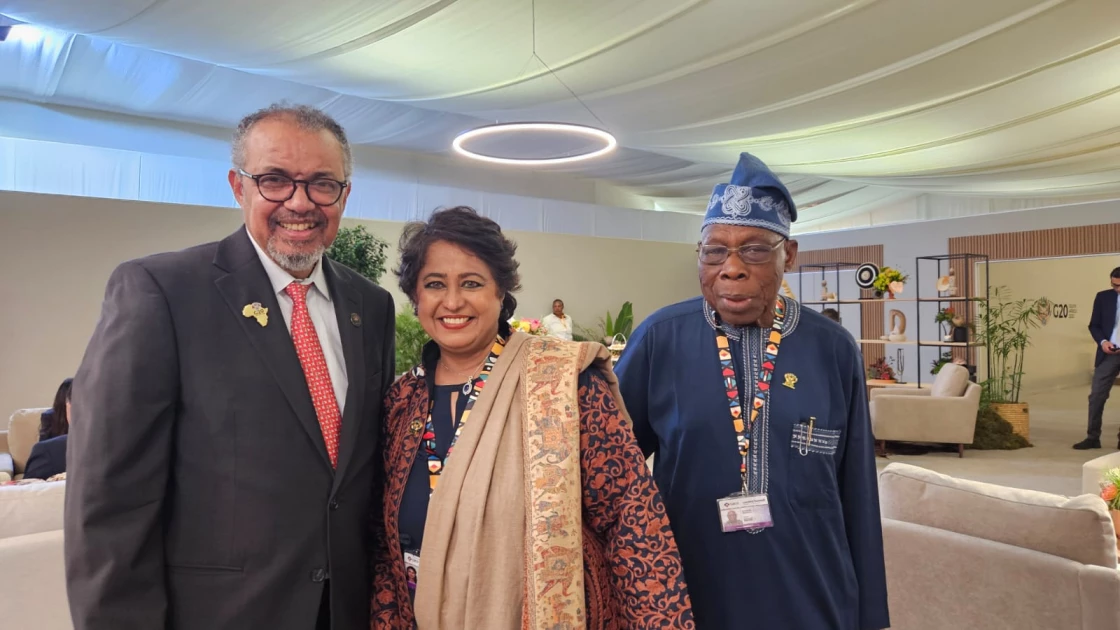
Former Nigerian president Olusegun Obasanjo, who together with Ameenah Gurib-Fakim, former President of Mauritius, represented the Guardians Circle of the Accra Reset at the G20 Leaders Summit, backed the call to “rebalance” the architecture of global power to restore legitimacy.
Health financing has emerged as an early test case for the Accra Reset. With global health aid declining, the Africa Centres for Disease Control and Prevention has warned that the continent remains overly dependent on imports for essential medicines and vaccines.
In a recent strategy paper, Africa CDC said that predictable regional demand and financing mechanisms are critical to sustaining local manufacturing.
The Alliance of African Multilateral Finance Institutions (AAMFI), an early Accra Reset supporter that recently launched a $1.5 billion financial vehicle to help drive down the cost of capital for infrastructure on the continent, has persistently called for “Africa’s collective ambition to take charge of its own development financing.”
South African officials say similar logic applies to climate finance, food systems and industrial development.
Deputy Finance Minister David Masondo said during the G20 finance track meetings that public funds should be used more strategically to reduce risk and crowd in private investment.
“We need instruments that unlock capital at scale, not just short-term projects,” he said.
However, there’s caution that investment-led models carry risks if safeguards are weak and private capital avoids poorer or higher-risk regions.
Civil society groups have also warned that reforms to the G20’s Common Framework for debt restructuring have been too slow to deliver relief.
Still, development economists say the Accra Reset reflects a broader shift in thinking.
A recent Brookings Institution analysis on global financial reform argued that the current system no longer reflects economic realities and that emerging and developing economies must play a larger role in shaping rules and institutions
.
As South Africa hands over the G20 presidency, the question is whether the momentum behind the Accra Reset can be translated into concrete deals.
Its backers say success will be measured not by declarations but by whether new financing pipelines, regional procurement systems and blended finance platforms begin to deliver investment at scale.
Leave a Comment