
OPINION: The drought is here, and only technology, foresight, and policy will save us

Audio By Vocalize

Kenya is walking—quietly and dangerously—into one of the most severe agricultural crises in recent memory.
Recently,
the Government flagged 22 counties as hard-hit by the deepening
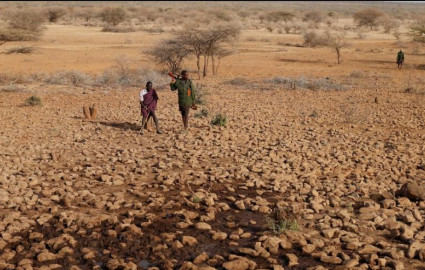
drought. What is emerging on the ground is nothing short of heartbreaking:
carcasses of livestock strewn across empty plains, soils cracking under a
merciless sun, and fields of maize and beans curling into brittle husks.
Even counties long considered part of Kenya’s traditional
food basket—Meru, Embu, Trans Nzoia, Uasin Gishu, Bungoma and Nakuru—are
reporting failures that would once have been unimaginable. If these regions,
the backbone of the country’s food systems, are faltering, then the
implications are far more serious than many are willing to admit.
Just weeks ago, millions of farmers planted in hope. They ploughed their land, procured seed, bought fertilizer, paid labourers and prepared their fields for what the Kenya Meteorological Department repeatedly described as enhanced short rains. But the sky refused to cooperate.
The rains
came late, stopped early, or failed to appear entirely. Today, fields that
should be thriving with food are instead brown and lifeless. The tea sector,
the country’s most important agricultural export, is also suffering. The season
that ordinarily opens with heavy flushes has instead begun with depressed
yields, guaranteeing reduced earnings for farmers and for the nation.
A bad farming year is always a bad economic year for Kenya, and this year is shaping up to be particularly painful. The agricultural supply chain is already in distress. Agro-dealers and distributors—who stocked their shelves in anticipation of normal planting—are now watching their inventory gather dust. With no crops to fertilize, no weeds to spray, and no harvests to support, their losses will soon become visible.
When agricultural seasons
collapse, so too does every link in the value chain. Transporters, processors,
exporters and retailers are all beginning to feel the
shockwaves. Consumers too are fearing increased prices as shortages
bite.
Yet even in this bleak moment, innovation offers a path forward. Elgon Kenya has, for years, invested in preparing farmers for the inevitability of rainfall failure. The company has worked across the country to expand the use of climate-resilient tools—from irrigation systems, dam liners to greenhouse solutions.
Its partnerships with
drone-technology companies are enabling farmers to detect crop stress, pests
and nutrient deficiencies long before the human eye can see them. These tools
do more than solve problems; they anticipate them. In a climate where the rains
can no longer be trusted, such technologies are becoming essential safeguards
for farmers’ livelihoods.
The Meteorological Department has now warned that no
significant rains are expected until March next year. Yet this same institution
has, season after season, forecast rains that failed to materialize. Farmers
trusted the forecasts and paid for that trust with total crop loss. Kenya
urgently needs a weather service that is modern, accurate and localized—one
that farmers, counties and investors can rely on. Weather forecasting is not a
luxury; it is a prerequisite for national planning.
But not all crises are about rain. Even in good years, Kenya loses vast amounts of produce to poor storage and a lack of processing facilities. Post-harvest technologies are becoming as important as irrigation.
Cold storage for vegetables, fruits and potatoes, along with modern silos and
value-addition plants for a wide range of produce, must become part of the
national food-security conversation. Kenya will also have to rebuild and expand
its strategic food reserves, ensuring the country can withstand at least four
consecutive rainless seasons—because climate variability is no longer an
exception but the norm.
Beyond technology and storage, Kenya must return to the basics of environmental stewardship. Rainwater harvesting should become standard in every household, institution and county. Wetlands, our natural water banks, must be protected and restored.
Forests must be rehabilitated, and
tree planting must evolve from a ceremonial exercise into an enforceable
national practice. Every farm should be encouraged—if not required—to set aside
a portion of its land for trees to help improve microclimates, reduce runoff
and restore local water cycles. Without trees, there is no water; without
water, there is no agriculture; without agriculture, there is no Kenya.
This drought may not have been predictable in timing, but it
was predictable in inevitability. Rainfall patterns have shifted, yet our
systems remain anchored to assumptions from another era. Kenya cannot continue
planting based on hope, harvesting disappointment and repeating the same cycle
each season. The tools to build resilience already exist; the expertise exists;
and the innovators are ready. What the country needs now is the political will
to convert knowledge into action.
If Kenya is to avoid a future defined by recurring hunger, rising food prices and widespread loss of livelihoods, then rainwater harvesting, irrigation, accurate weather forecasting, post-harvest management and environmental restoration must become national priorities. No farmer, no supply chain and no household should remain at the mercy of uncertain clouds. The time for speeches has passed. What Kenya needs now is decisive action that matches the scale of the crisis before us.
Leave a Comment