
OPINION: The coffee Kenya grows but cannot afford to keep
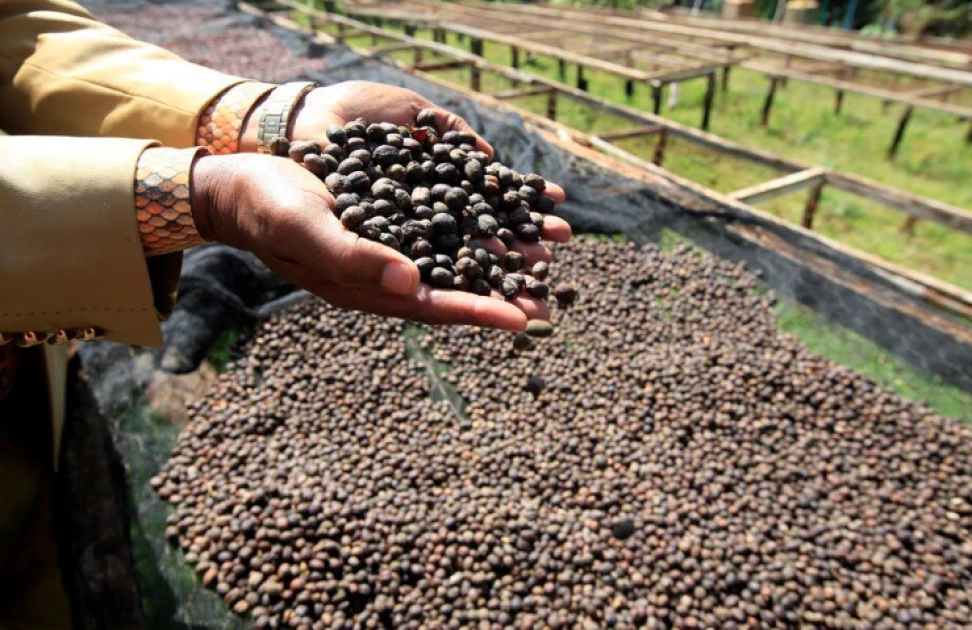
A worker holds coffee berries to sundry at the Bradegate coffee factory in Karatina near Nyeri, Kenya June 3, 2021. REUTERS/Monicah Mwangi

Audio By Vocalize

There are a few bags of Kenyan coffee in my suitcase. Roasted in Kenya, branded in Kenya, grown on an estate a short drive from Nairobi. A restaurant in London wants to taste them. It is a small shipment. It is also, in miniature, the answer to a question Kenya has been dodging for a hundred years.
The good news is real. Kenyan coffee is booming. Prices at the Nairobi
Coffee Exchange hit record
highs last year.
They touched Ksh.1,025 a kilogram to mark a 60 per cent rise in a year. Farmers
selling directly to overseas buyers are doing even better. Their coffee has
fetched around Ksh.51,000 for a 50-kilo bag against Ksh.37,000 at auction. The reforms are biting. The market is opening. The farmer
is smiling.
Almost all of that coffee still leaves Kenya as raw green beans. The
world is paying us more than ever for our harvest. Yet we sell it the way our grandfathers
did. Beans in a sack. Onto a ship. Gone.
Where does the rest of the money go? Follow the supply chain. A farmer
earns perhaps Ksh.150 for a kilo of cherry. It takes six or seven kilos of
cherry to make one kilo of the roasted coffee in my suitcase. Call it Ksh.1,000
of cherry in every finished kilo. In London this week that kilo sells for up to
Ksh.8,000 in a branded bag. His hands. My suitcase.
Their shelf. The farmer takes a fraction.
The rest of the value is added after export.
Nobody stole that margin. It was earned, step by step, just not by us.
Someone roasted the coffee. Someone designed the bag. Someone gave it a name
and put it on a shelf where
a Londoner would
happily pay for it. Nearly
every one of those
steps happens abroad. Some of those bags even carry the names of our own hills, coffee sold proudly abroad as
Othaya, at prices no one in Othaya will ever see.
We grow the story. Others get paid for telling it. We know this pattern
because we live it everywhere. We export raw tea to buy back tea bags. We
export hides to buy back shoes. We sell the harvest cheap. We buy back the
finished product at a premium. Coffee stings the most because the world already
knows our name. Kenyan coffee is a global brand. Kenya does not own it.
The recent reforms have done real good. They all fight for a fairer price
for the green bean. Open auctions. Direct sales. Faster pay for farmers. These
are all necessary. Yet they remain a fight over a raw material. The bigger
prize sits untouched. The roasting. The bag. The brand. The shelf.
We are heading into an election year. Coffee will feature at every rally in the growing counties. Here is a simple test for every promise. Does it fight for a better price for the raw bean? Or does it fight for Kenya to own the roast, the brand and the shelf? The first puts money in the farmer's pocket this season. The second changes what his grandchildren inherit.
The bags in my suitcase are a small thing. They were roasted here. They
were branded here. They will be tasted in London as a finished
Kenyan product rather than a raw material. If they
succeed then the margin comes home. That is the whole idea. It fits in a
suitcase.
Join the Discussion
Share your perspective with the Citizen Digital community.
No comments yet
This discussion is waiting for your voice. Be the first to share your thoughts!