
Kenya’s sugar retail prices fall as production rises by 56.7%
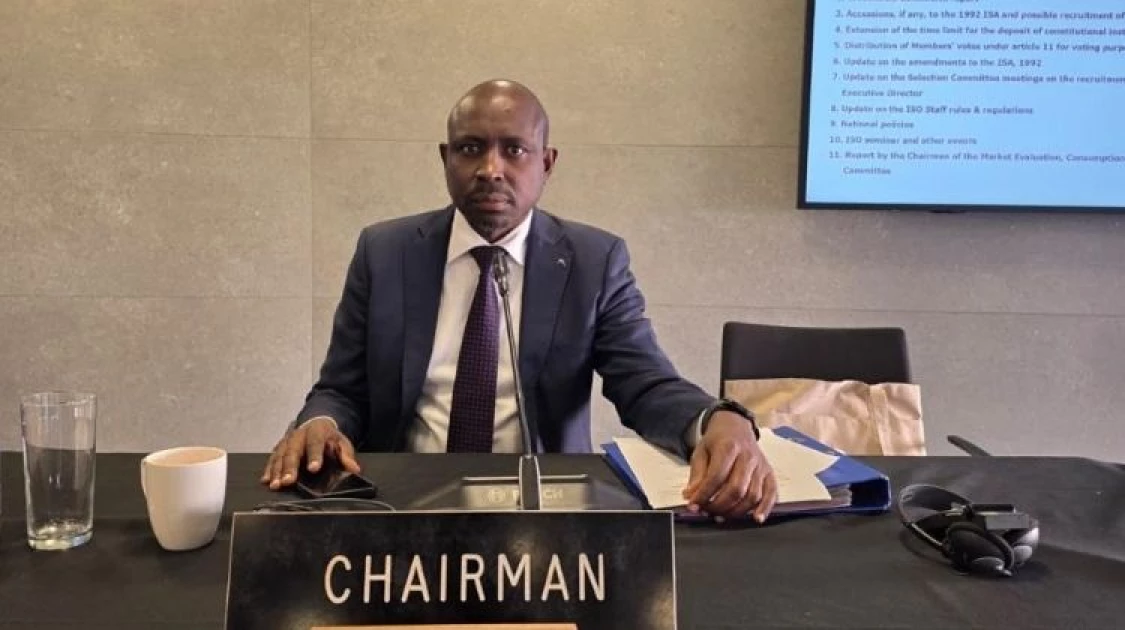
A photo of Kenya Sugar Board CEO Jude Chesire. Photo/Courtesy

Audio By Vocalize
The Board’s Chief Executive Officer Jude Chesire said on Friday, during an International Sugar Organization (ISO) Council meeting in London, that Kenya produced 690,521 tonnes of sugar in the period, a 56.7 per cent increase from the same period last year bringing the equivalent cost of two kilograms down by Ksh.32.
He said that the cumulative sugar production increased from 440,652 tonnes between January and September 2025.
Kenya projects 900,000 metric tonnes (MT) of sugar against a demand of 1 million compared to a production of 650,000 MT last year.
Factories processed 7.76 million tonnes of sugarcane, compared with 4.97 million tonnes in 2025.
For consumers, the production gains coincided with lower retail prices compared with a year earlier, although the reduction was not uniform across outlets and counties.
The national average retail price stood at Ksh.155 per kilogram in September 2026, against Ksh.171 in September 2025.
At those averages, two kilograms cost approximately Ksh.310, compared with Ksh.342 a year earlier. The Ksh.32 difference offers some relief on a regularly purchased household commodity, particularly for families balancing food, transport and other daily expenses.
The national production increase was accompanied by a reduction in sugar imports.
Between January and September, Kenya imported 251,690 tonnes, compared with 364,486 tonnes during the same period in 2025 — a decline of approximately 31 per cent, or 112,796 tonnes.
The sharpest reduction was in mill white and brown sugar, whose imports fell by about 71 per cent to 65,845 tonnes from 226,730 tonnes.
Refined white sugar imports, however, increased to 158,006 tonnes, from 137,756 tonnes. This indicates that the country’s supply challenge involves both the volume produced and the ability of local processors to meet demand for different sugar categories.
Sugar stocks at the end of September stood at 70,773 tonnes, against 14,033 tonnes a year earlier, providing a larger inventory buffer than at the same point last year.
Likewsie, exports rose to 315.57 tonnes in the same period, compared to 244.80 tonnes during the corresponding period in 2025.
The improved national supply comes as CEO Chesire, who chairs the ISO Council, helped resolve a leadership stalemate at the organisation a role Kenya is seeking to use to advance discussions on export markets and investment in sugar processing.
Chesire initiated consultations among member states after three rounds of voting failed to produce a candidate with the required two-thirds majority for the Executive Director position.
The Council subsequently agreed that Devesh Devani of Mauritius would serve the first four-year term, followed by Eduardo Leão de Sousa of Brazil for the succeeding four years.
The agreement followed inconclusive formal voting on September 22, 2026. It places Kenya in a convening role within the international sugar industry at a time when its domestic production is growing and attention is turning to how that growth can be sustained.
For cane-growing communities, the increased annual processing volumes mean more cane has passed through factories.
Chesire’s ISO role gives Kenya an opportunity to engage producing and consuming countries on market access, processing technology and diversification.
“Kenya by next year will start building surpluses for exports and requires such a platform to create new markets,” Chesire said.
A further area of engagement is ethanol and biofuels, with Chesire identifying Brazil as a country from which Kenya will benchmark.
“Conversations are now building up towards biofuels and ethanol production,” he said.
Join the Discussion
Share your perspective with the Citizen Digital community.
No comments yet
This discussion is waiting for your voice. Be the first to share your thoughts!