
Kenya courts Italy to accelerate energy sector growth

Audio By Vocalize
The government is pursuing the partnerships through the implementation of a three-year cooperation plan with Italy, following President William Ruto's state visit to Rome in April 2026, during which Kenya and Italy agreed to deepen cooperation in strategic sectors, including energy.
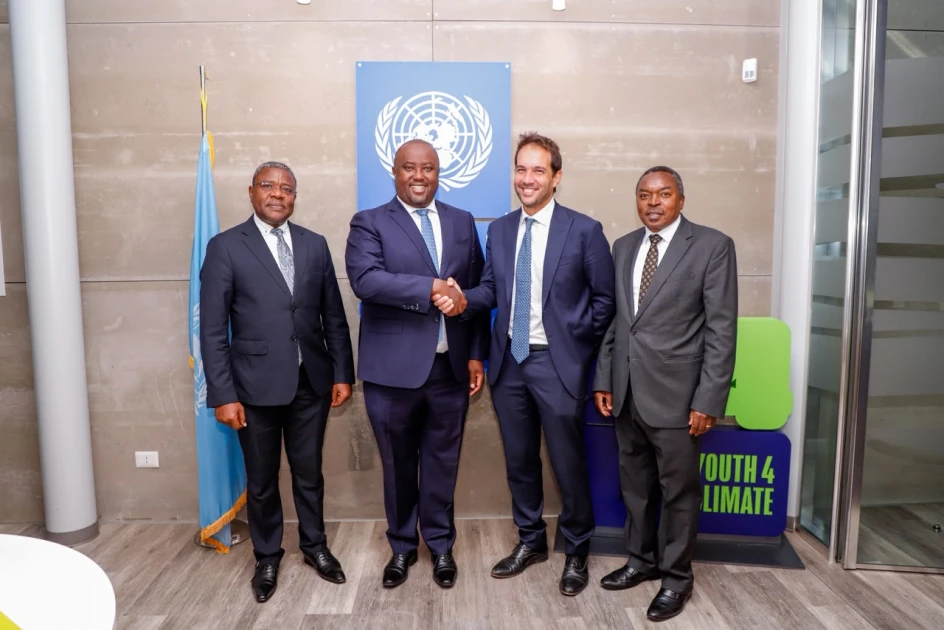
The latest engagements took place during a three-day energy cooperation mission to Italy from October 26 to 28, led by Principal Secretary for Energy Alex Wachira.
The delegation held discussions with Italian development finance institutions, representatives involved in implementing the Mattei Plan for Africa and the United Nations Development Programme (UNDP), among other stakeholders.
The mission sought to advance the 2026–2029 Kenya-Italy Action Plan under the Mattei Plan, an Italian government initiative aimed at building partnerships with African countries through investment in key sectors such as energy, agriculture, water, education, healthcare and infrastructure.
In the energy sector, the plan focuses on expanding electricity access, supporting renewable energy development, strengthening transmission and distribution infrastructure, and promoting energy technologies and skills development.
Kenya is among the African countries participating in the initiative, which Italy launched in 2024 to promote economic cooperation and support development priorities across the continent.
During the October meetings, Kenya presented investment opportunities in geothermal, wind, solar and hydropower generation, battery storage, electricity transmission, clean cooking and electric mobility.
Discussions with Italy's development finance institution, Cassa Depositi e Prestiti (CDP), focused on financing Kenya's geothermal project pipeline, including feasibility studies, drilling and the development of new power plants through the Geothermal Development Company (GDC) and Kenya Electricity Generating Company (KenGen).
The two sides also explored potential support for transmission infrastructure, grid improvements, last-mile electricity connections and clean cooking initiatives using liquefied petroleum gas (LPG) and biogas.
Other discussions covered electricity access in informal settlements, mini-grids for communities beyond the national grid, biofuel development and technical assistance for the energy sector.
The delegation also explored opportunities for renewable energy training and skills development for young Kenyans through potential partnerships involving Strathmore University and the University of Nairobi.
Speaking during the engagements, Wachira said the mission was aligned with the objectives of the Mattei Plan and the global Mission 300 initiative, which seeks to expand electricity access across Africa.
"Our presence in Rome aligns directly with the strategic vision of the Mattei Plan for Africa and the global Mission 300 initiative, both of which recognize that sustainable economic sovereignty cannot exist without transformative energy infrastructure," he said.
The PS also presented Kenya's National Energy Compact 2025–2030, which sets out the government's targets for expanding electricity access, increasing clean energy generation and improving access to clean cooking by the end of the decade.
Under the compact, Kenya targets connecting an additional 5.1 million households to electricity by 2030, bringing the total number of connected households to approximately 15 million.
The plan identifies grid densification, grid intensification, grid extension, mini-grids and standalone solar systems as key approaches to reaching households that remain without electricity.
The government also aims to achieve universal access to clean cooking by 2030, up from a national baseline of 34.4 per cent. The strategy includes expanding access to LPG and other cleaner fuels, supporting the adoption of electric cooking and transitioning public educational institutions away from firewood and charcoal.
The compact further targets increasing renewable energy generation capacity to 5,952 megawatts by 2030 and transitioning the national electricity grid to 100 per cent clean energy.
To support these ambitions, Kenya plans to expand its transmission network by 8,000 kilometres and its distribution network by 212,937 kilometres. It also seeks to increase regional electricity trade and scale cross-border power import and export capacity to 1,000 megawatts by 2030.
The government is also seeking greater private sector participation in the energy sector, with plans to use public-private partnerships, standardised power purchase agreements, green bonds and other financing arrangements to attract investors.
The National Energy Compact identifies a combined public and private financing requirement of approximately $17.51 billion by 2030. Of this amount, US$13.42 billion is expected from public funding, while US$4.09 billion is projected from private investment.
Wachira said the government was looking to attract private capital through projects offering commercial opportunities for equity partners, banks and long-term developers.
"Within this portfolio lies a private capital investment opportunity with projects designed specifically for commercial equity partners, commercial banks, and long-term project developers who demand bankable off-take structures, clear regulatory certainty, and competitive financial returns," he said.
The Kenya-Italy Energy Investment Roundtable, held under the theme ‘Advancing Kenya's Clean Energy Future Through Strategic Partnerships’, provided a platform for the government to present its energy project pipeline and engage potential investors.
The discussions come as Kenya seeks to address gaps in electricity and clean cooking access while strengthening its energy infrastructure and reducing reliance on traditional fuels.
According to the National Energy Compact, electricity access increased from approximately 30 per cent in 2014 to more than 75 per cent in 2024. However, about a quarter of the population remained without electricity, while more than 69 per cent of households continued to rely on traditional biomass for cooking.
Through its partnership with Italy, Kenya hopes to mobilise financing, technical expertise and private sector participation to turn its energy development plans into bankable projects and accelerate progress towards its 2030 targets.
Join the Discussion
Share your perspective with the Citizen Digital community.
No comments yet
This discussion is waiting for your voice. Be the first to share your thoughts!