
Kenya bets on sports economy to unlock youth opportunity ahead of France–Africa Summit
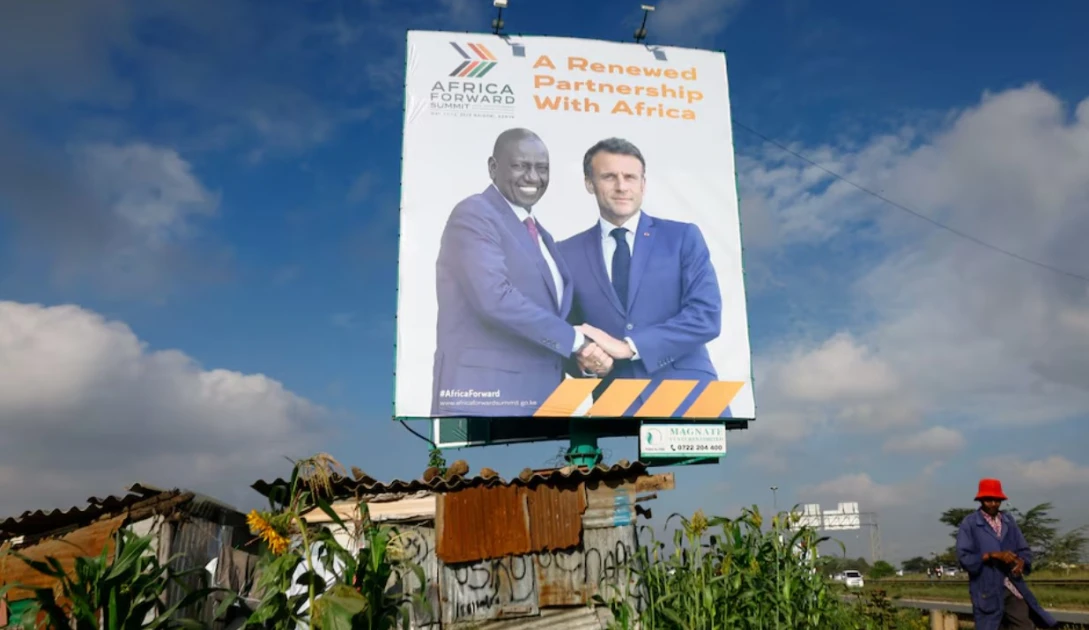
A pedestrian walks near a billboard featuring Kenyan President William Ruto and French President Emmanuel Macron ahead of the "Africa Forward" Summit, in the outskirts of Nairobi, Kenya May 7, 2026. REUTERS

Audio By Vocalize
In Kenya, where young people make up nearly 75 per cent of the population, sports is increasingly being positioned as a key pillar for youth empowerment, employment creation, and economic growth.
The government has, in recent years, intensified investment in sports infrastructure, talent development, and international partnerships as part of a broader strategy to transform sports into a sustainable economic sector.
From grassroots football tournaments and school competitions to athletics academies and youth leagues, sports is increasingly being viewed not only as recreation but also as a pathway to employment, mentorship, leadership development, and national cohesion.
At the grassroots level, President William Ruto’s administration is rolling out Constituency Sports Academies aimed at identifying and nurturing talent across the country. The initiative seeks to provide young athletes with access to quality training facilities, structured mentorship, and pathways into professional sport.
Programmes such as the Talanta Hela Digital Hub — a government-backed platform focused on identifying, nurturing, and monetising talent in sports and the creative economy — further reflect growing recognition that sports and entertainment can jointly drive economic empowerment among young people.
The government is also prioritising the renovation of major sporting facilities, including Moi International Sports Centre, Kasarani and Nyayo National Stadium, alongside the upgrading of community sports grounds to improve access for aspiring athletes.
According to President Ruto, investment in sports and the creative economy will “create pathways for young people to turn talent into sustainable livelihoods and meaningful careers.”
Deputy President Kithure Kindiki has also defended the administration’s increased spending on sports infrastructure and talent development.
“Since Kenya came into being, no administration has invested in the modernization of sports infrastructure and development of talent through sports more than the current administration. The last time Kenya hosted a major international football tournament was in 1987 during the All Africa Games,” he said.
Support for young talent is also expanding through partnerships involving government agencies, private sector investors, and sports federations. In Nairobi, the county government is developing a modern arena and entertainment district in the Railway area, a project expected to position the city as a regional basketball hub capable of attracting talent, investors, and fans from across Africa and beyond.
The government has further revised reward structures for medal-winning athletes. Under the new framework, athletics gold medalists will receive KSh3 million, silver medalists KSh2 million, and bronze medalists KSh1 million. Commonwealth Games gold medalists will receive KSh2.5 million, silver medalists KSh1.5 million, and bronze medalists KSh1 million.
To strengthen governance and accountability within the sector, the government has proposed the Sports Bill 2026, which seeks to establish a National Sports Regulatory Authority to enforce standards and improve oversight across sporting institutions.
“These measures are designed to support sports development and ensure that our young men and women have every opportunity to nurture and advance their talents,” President Ruto said.
With one of Africa’s youngest populations, Kenya is increasingly seeking partnerships capable of expanding both the sports and creative economies while helping athletes and creatives build sustainable careers. It is within this context that growing cooperation between Kenya and France is gaining significance ahead of the upcoming France–Africa Summit 2026 scheduled for May 11–12 in Nairobi.
The partnership is increasingly being presented as an example of how sports diplomacy can unlock economic opportunity, cultural exchange, and youth empowerment.
As part of the cooperation, the city of Miramas in southern France has repeatedly hosted Kenyan athletes and teams. African sprint record holder Ferdinand Omanyala trained there ahead of the 2024 Summer Olympics, while the Harambee Starlets also held training sessions there earlier this year in preparation for the 2026 Women’s Africa Cup of Nations qualifiers.
Last year, Tennis Kenya signed a strategic collaboration agreement with the French Tennis Federation aimed at expanding international training and competition opportunities for Kenyan players. The partnership also provides technical exchange programmes for coaches and officials, particularly in clay-court development.
Beyond athlete exchange programmes, France has also committed approximately 60 million euros toward improving sports infrastructure in Kenya. The funding is intended to support talent development, sports inclusion programmes, and infrastructure projects targeting youth, women, and vulnerable communities.
As Kenya prepares to co-host the 2027 Africa Cup of Nations alongside Uganda and Tanzania, the partnership with France is also expected to provide lessons in hosting major global sporting events.
France’s hosting of the 2024 Summer Olympics demonstrated the country’s strengths in infrastructure planning, event management, branding, ticketing systems, sports tourism, and commercial partnerships. Reports indicating the Games closed with a financial surplus have further strengthened arguments that sports can become a sustainable economic enterprise when supported by long-term planning and investment.
For Kenya, the opportunity extends beyond competition and medals. Analysts argue the country can draw lessons from France on how to build a broader sports economy through sportswear manufacturing, digital content production, broadcasting rights, sports science, and sports tourism.
Women’s football remains another area with significant untapped potential despite ongoing expansion efforts by the Football Kenya Federation. France’s emphasis on gender inclusion in sports financing has increasingly been cited as a useful model for Kenya.
One recent example was the decision by the French Football Federation to split sponsorship funding from telecommunications company Orange equally between men’s and women’s football — a move widely viewed as a milestone in promoting gender equity in sports financing.
Kenya has also begun linking sports development with streaming platforms, digital storytelling, social media production, and mobile technology as part of efforts to expand opportunities within the wider creative economy.
In a recent interview with NTV Kenya, French Ambassador to Kenya Arnaud Suquet said combining French expertise with Kenyan talent and investment could help transform sports and the creative economy into sustainable engines of growth capable of empowering future generations.
Kenya is already globally recognised for its dominance in athletics, particularly long-distance running. The next challenge, however, is converting that sporting reputation into a broader economic and diplomatic asset.
The upcoming summit is expected to build on previous cooperation between Kenya and France while exploring how sports, culture, and economic development can jointly drive job creation and youth empowerment.
A session scheduled for May 11 under the theme “Inspire and Connect” will focus on youth-focused sectors capable of generating employment and strengthening social cohesion, including sports and the cultural and creative industries. Presidents Ruto and Emmanuel Macron are expected to attend the discussions.
“Sport directly contributes to improving health, education, gender equality, and social cohesion. It is a powerful driver of socioeconomic development for our societies and for future generations,” summit organisers noted ahead of the event.
This year’s summit is also significant as the first France–Africa Summit to be hosted in Anglophone Africa, with several resolutions expected to focus on strengthening economic cooperation between African countries and France.
However, analysts warn that the long-term success of the sporting and cultural initiatives discussed at the summit will depend heavily on implementation. Kenya has historically struggled to fully execute agreements reached during high-level international forums.
According to Principal Secretary for Foreign Affairs Korir Sing’Oei, implementation gaps remain one of the biggest challenges facing international cooperation frameworks.
“Commitments are often made, but implementation remains uneven, with progress slower than both ambition and necessity would suggest,” he said.
Future summit resolutions are therefore expected to focus not only on diplomacy, but also on practical partnerships capable of supporting local sports businesses, talent management, sports science, creative industries, and sports-linked entrepreneurship.
If properly managed, sports could emerge as one of Kenya’s most powerful engines for economic growth, youth empowerment, and international influence.
Join the Discussion
Share your perspective with the Citizen Digital community.
No comments yet
This discussion is waiting for your voice. Be the first to share your thoughts!