
JSC begins interviews for Court of Appeal judges
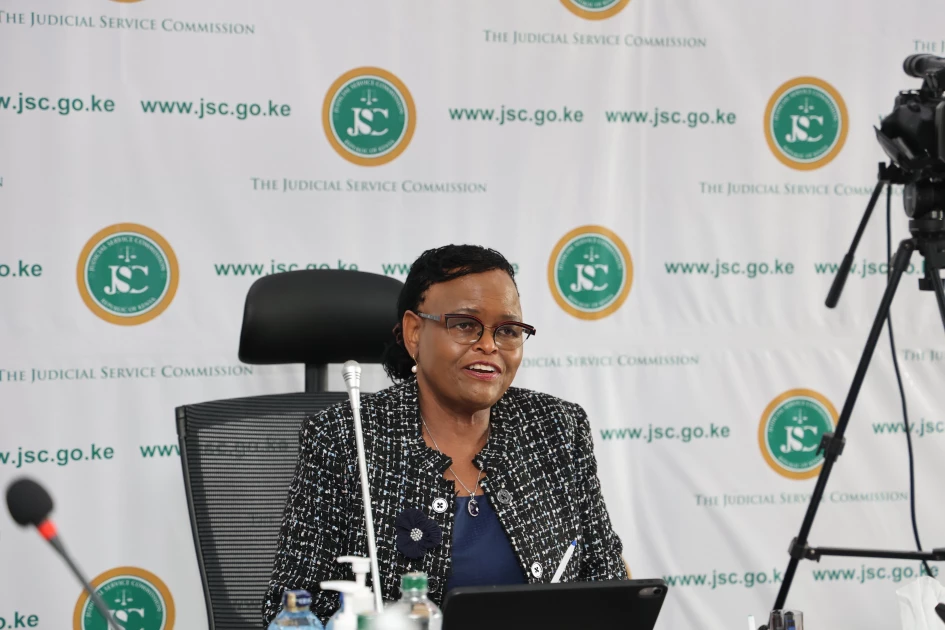
Chief Justice Martha Koome, chairperson of Judicial Service Commission. Photo: JSC/X

Audio By Vocalize
During his interview, Professor Akech was put to task with a question on the procedure for the removal of Cabinet Secretaries (CSs) from office.
The panel noted that while the Constitution sets out the grounds for removal, it appears silent on the exact procedure to be followed by the President, and asked whether a Cabinet Secretary dismissed by the President should be entitled to due process.
In response, Professor Akech emphasized the need for an effective government and a strong executive. He argued that the President must be sufficiently empowered to govern effectively, including having discretion to appoint and relieve Cabinet Secretaries. According to him, this authority falls squarely within the realm of politics.
Professor Akech stated that the President should be given leeway to decide whom to work with and whom to relieve of their duties, noting that political appointments cannot be treated in the same manner as ordinary employment relationships.
He explained that the due process applicable to a regular employee cannot be equated to the removal of a Cabinet Secretary, whose position is inherently political.
Despite being widely known as a defender of human rights and constitutionalism, Professor Akech maintained that the removal of Cabinet Secretaries is a political decision that must allow the President freedom of action. He cautioned that insisting on rigid procedures akin to employment law could undermine the effectiveness of the executive arm of government.
“We must have an effective executive,” he insisted, reiterating that political accountability and executive efficiency require a different approach from conventional employer–employee due process standards.
On public participation, Professor Akech observed that it affects all aspects of public life but remains a subjective concept. He cited the Building Bridges Initiative (BBI) case as an example, noting that judges themselves differed on what constituted adequate public participation.
He argued that courts can strengthen public participation without undermining the legitimate expectations of legislators by developing clearer, contextual indicators rather than rigid or one-size-fits-all standards. “We need more to be able to have contextual indicators,” he said.
On performance and docket management, Professor Akech told the panel that he has authored over 80 academic articles and expressed confidence in his ability to handle the workload of the Court of Appeal if appointed.
Leave a Comment