
‘Ikuje Garre, iteremke Modogashe’: Ruto recalls ridicule over viral Northern Kenya road remarks
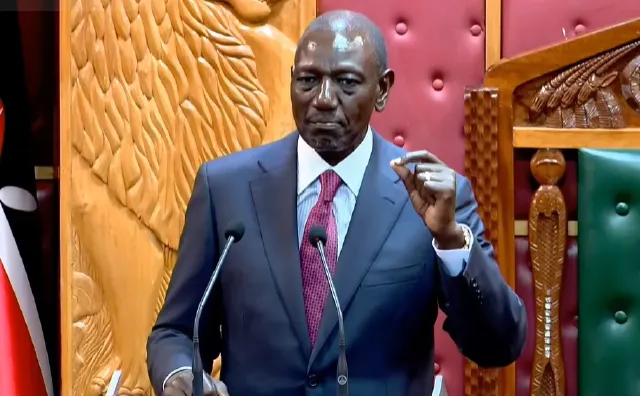
President William Ruto makes his State of the Nation Address to Parliament on November 18, 2026.

Audio By Vocalize
Speaking during his State of the Nation Address to Parliament on Wednesday, Ruto said Kenyans had turned his remarks into a subject of humour when he initially outlined the road's route, admitting that he had also found some of the jokes hilarious.
“When I first spoke about this road and named all the towns it would pass through, Kenyans had a field day. The jokes and parodies were everywhere. I saw some of them myself, and I must admit, some were quite hilarious,” he said.
However, the President urged Kenyans to look beyond the humour, arguing that the road represented a long-overdue infrastructure connection for communities that had lived for decades without access to tarmacked roads.
Ruto was referring to the 750-kilometre Northern Kenya Gateway Corridor, which is expected to connect Isiolo, Wajir and Mandera, opening up the region to economic opportunities and improving access to essential services.
While explaining the route, he took Parliament through the various towns and trading centres the road is expected to traverse.
“Ile barabara ya kutoka Isiolo kwenda Modogashe, iteremke iende Samatar, iteremke mpaka Wajir, iende Tarbaj, itoke Tarbaj, ipitie Kotulo, iende Kobo, iende El-Wak, iende Garre, iende Rhamu, ifike Mandera,” he said.
The remarks revived memories of a viral moment in February 2025, when Ruto, during a tour of the North Eastern region, demonstrated his familiarity with the area's road network while outlining the proposed infrastructure project.
At the time, the President, addressing residents from atop his vehicle in Isiolo, gave a detailed breakdown of the route, saying:
“Ndio barabara itoke Mandera, ikuje Ramu, ikuje Garre, ikuje El-Wak, ikuje Kobo, ikuje pale Kotulo, ikuje Tarbaj, ipitie hapa Wajir, iende Samatan, iteremke Modogashe, ifike Isiolo, iende Nairobi.”
The speech quickly found its way onto social media, where Kenyans turned the President's seemingly effortless listing of the towns into viral entertainment.
TikTok users produced videos mimicking the President's delivery, with some turning the sequence of town names into dance challenges, while others created parodies depicting Ruto as a teacher giving Geography lessons.
Comedians also joined the trend, with videos inspired by the remarks attracting millions of views and hundreds of thousands of likes. Some Kenyans even printed T-shirts bearing phrases from the President's address.
The viral moment was further fuelled by remarks made by former Deputy President Rigathi Gachagua at the opening of the Democratic Action Party of Kenya (DAP-K) headquarters on January 28, 2025.
Gachagua narrated how Ruto had previously impressed residents in the Mt. Kenya region by demonstrating an intricate knowledge of local roads and markets, arguing that the President used the familiarity to win over crowds.
He recalled how residents would react with amazement whenever Ruto mentioned roads in their localities by name, during the lead up to the 2022 elections.
The combination of Gachagua's remarks and Ruto's North Eastern tour helped propel the road description into a nationwide social media trend.
But revisiting the episode in Parliament, Ruto said the infrastructure project should be understood through the lives of residents in the communities it is intended to serve.
“In those towns live Kenyans like you and me. Mothers raising children. Traders trying to make a living. Young people with dreams no different from those of your children and mine,” he said.
The President noted that some communities in the region had spent their entire lives without a single tarmacked road reaching their neighbourhoods, describing the disparity as one the government was seeking to address.
“Some have lived their entire lives without a single tarmacked road reaching their communities. Their entire lives. What many of us take for granted has remained a distant hope for other citizens. That is the inequality we are correcting. That is the Usawa they deserve,” Ruto added.
He said the infrastructure programme was part of his administration's broader commitment to economic inclusion, alongside initiatives such as the Hustler Fund, which seeks to extend affordable credit to small-scale traders and entrepreneurs traditionally locked out of formal financial services.
Ruto maintained that economic opportunities should not be determined solely by an individual's financial circumstances or access to conventional banking, arguing that improved infrastructure and access to credit were necessary to bridge historical inequalities.
Join the Discussion
Share your perspective with the Citizen Digital community.
No comments yet
This discussion is waiting for your voice. Be the first to share your thoughts!