
Gov't to release Ksh.23B school capitation funds before term two
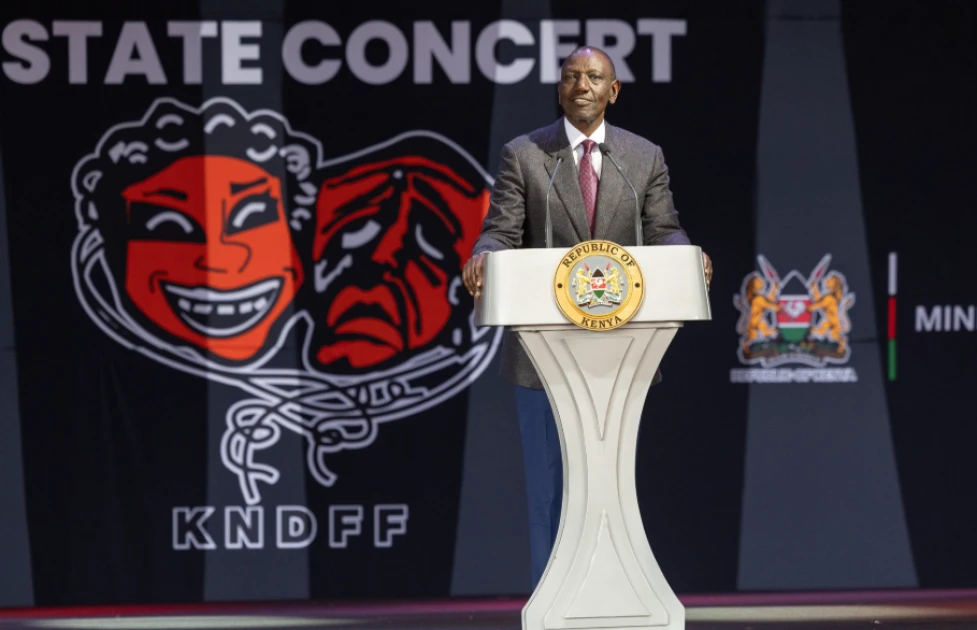
President William Ruto speaks when he hosted the 64th Kenya National Drama and Film Festival State Concert at State House, Nairobi, on May 17, 2026. PHOTO | PCS

Audio By Vocalize
The government will send capitation funds to schools before
they open for the second term, President William Ruto has announced.
The President said the Ministry of Education has already
received Ksh.23 billion to be released one week before the schools open.
“We want to ensure that delay of capitation funds becomes a
thing of the past,” the President said, pointing out that the government
released the funding early ahead of school reopening in January.
Delayed capitation, he said, has been a challenge for many
years.
“Funds to schools were being delayed for weeks and months, but
we are changing this,” the President said.
President Ruto was speaking when he hosted the 64th Kenya
Schools and Colleges National Drama Festivals at State House, Nairobi, on
Friday. He was accompanied by First Lady Rachel Ruto.
Art, the President said, has grown from being just a tool for
entertainment and expression into a massive opportunity for monetising talent.
He pointed out that many young people in the country are
actively using platforms such as TikTok, Instagram, and Facebook not only to
create and share content, but also to earn a living.
“It is no longer just space for artistic expression or
entertainment; it has become a formidable source of income and economic
opportunity,” he said.
The global creative economy, he noted, is currently valued at
over $250 billion (Ksh.32.5 trillion), with projections showing that it could
exceed $500 billion (Ksh.65 trillion) by 2030.
The performances at this year’s drama festival, the President
said, are topnotch, underlining the creativity of the youth.
“For the past 12 days, culminating in this State Concert, we
have witnessed an extraordinary display of talent, imagination, and creativity,
an inspiring celebration of culture that reflects the very soul, spirit, and
limitless potential of our nation at its best,” he said.
Storytelling, he pointed out, is at the heart of our cultural
vibrancy.
“From the rich oral narratives shared by our ancestors to the
performances we see today on our stages and across our screens, stories have
defined who we are,” he said.
The themes dramatised at the festivals include cohesion, drug
abuse and sexual violence against children.
President Ruto noted that, with the rapid advancement of
digital technologies such as artificial intelligence (AI), anyone with a phone
and the Internet “has the world as their stage”.
The President called on the youth to seize the opportunities
offered by the creative industry.
“It is not enough to simply recognise it; we must equip
ourselves and step forward with confidence and ambition to fully realise its
potential,” he said.
He said the government has recognised drama and film not
merely as co-curricula activities, but as integral to holistic development,
equipping Kenya’s youth with the skills, creativity, and confidence needed to
thrive in the 21st Century.
The President explained that the shift to the Competency-Based
Education and Training (CBET) is aimed at recognising multiple capabilities and
nurturing diverse talents among learners.
“We are equipping learners with critical thinking,
collaboration, communication, and problem-solving skills,” he said.
Under CBET, he noted, learners choose pathways early enough
and hence have ample time to perfect their talents and skills.
“In CBET, no student is a failure because they are given an
opportunity to discover themselves,” the President said.
On the government’s massive investment in education in the
past three years, President Ruto cited the recruitment of 100,000 teachers
while another 20,000 will be hired before the end of the year.
Additionally, he said, the government has built 23,000 schools
to ensure that education is accessible and CBE becomes a success.
The President also said the government is developing a new
platform, known as the Soma Play, to usher the drama and film festival into the
digital era.
The platform, he said, is “where talent meets opportunity,
where creativity is not only showcased, but also monetised”.
“It will market the incredible work emerging from this
festival and connect schools and the Kenya Institute of Curriculum Development
(KICD) directly to the creative economy,” he said.
He also announced that the government has taken a major step
by migrating the collection and distribution of music royalties onto e-Citizen.
“This is a bold and transformative reform,” he said, noting
that it will cut out brokers who have been living off the sweat of content
creators.
“Content creators should benefit more than anybody else from
their work,” President Ruto said, adding that, for too long, royalty collection
has lacked transparency.
“In one instance, a Collective Management Organisation
collected Ksh.109 million on behalf of artistes but distributed only Ksh.13 million,”
he said. “The rightful beneficiaries received only 12 per cent while cartels
and middlemen took the rest. That is not only unfair, but it is also an
injustice.”
The President also announced that the Public Service
Commission has approved the staff structure for the State Department of
Creative Economy.
This major step, he noted, will help bring in talent and
expertise into government to help drive the vision forward.
On legislation, he pointed out that the Creative Economy Bill,
2026, now before Parliament, would establish a fund to support creatives.
“It will also enable government to invest in large-scale
productions because telling our own stories at scale is no longer optional; it
is necessary,” the President stated.
Additionally, the President directed the Ministry of ICT,
through the Government Advertising Agency, to work more closely with content
creators.
“We have spoken for long about allocating 30% of government
advertising to creatives,” he said. “This year, I expect measurable progress.”
Just like in advertising, he said, heavy investments should be
made on platforms “that shape minds and culture”.
On independent content creators, the President they will be
brought into the mainstream drama festival.
“Some of these individuals - often referred to as “Mamluki”
within festival circles because they are not teachers and are not registered by
the Teachers Service Commission - have operated in unclear spaces,” the
President said.
He added: “It would be inconsistent for the festival to invest
in training, nurturing, and developing this talent only to leave it without a
clear pathway for growth and inclusion.”
He called on the KICD, the Kenya Cultural Centre, the Festival
Executive Committees and relevant ministries to develop clear guidelines for
vetting, accrediting, and engaging these talents.
Some of the performances that thrilled the audience at the
State House Concert are “Fourth Wiseman”, a play by FesBeth School from
Kakamega. The play lays bare the challenge of drug abuse among young people.
Stand-up comedies “Kingeumana” and “Saizi Yangu” by Tabaka
Senior School from Kisii County and Chuka Boys respectively also captivated the
audience. A choral verse by Agoro Sare School from Homa Bay County also drew
applause from the crowd.
Additionally, another play that shook the grounds at State
House was “Gari la Kucheza” by Diligent Willz Academy from Coast region, which
highlighted the significance of partnership in various undertakings.
The President commended the performance, saying it speaks to
the unity that we yearn to forge if our nation is to make meaningful progress.
“That performance was a beauty. It shows that, together, we
can build what is broken into something even better,” the President said.
Join the Discussion
Share your perspective with the Citizen Digital community.
No comments yet
This discussion is waiting for your voice. Be the first to share your thoughts!