
EACC warns of political interference in county recruitment, reveals MCAs demand jobs for relatives

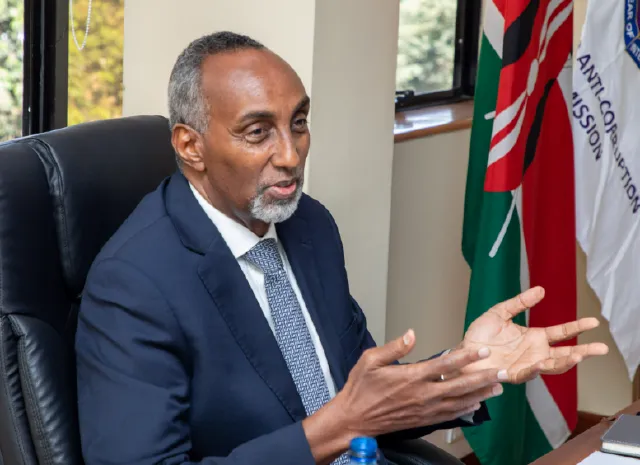
EACC Chief Executive Officer Abdi Mohamud during a past addres. PHOTO | COURTESY

Audio By Vocalize
EACC Chief Executive Officer Abdi Mohamud said some MCAs have sought to influence recruitment by demanding that a share of advertised vacancies be reserved for their preferred candidates, compromising the independence of County Public Service Boards and weakening accountability in county governments.
In a speech delivered on his behalf by EACC Western Regional Manager Eric Ngumbi during the launch of a systems review and corruption risk assessment at the Kakamega County government on Tuesday, Mohamud warned that such practices were deepening corruption in county administrations.
"The commission has also encountered situations where some Members of County Assemblies demand that a share of advertised employment opportunities be reserved for their relatives, associates and political supporters, in exchange for a promise not to demand accountability from the Executive or the County Public Service Boards," the CEO said.
He cautioned that the practice compromises oversight and entrenches corruption in county institutions.
The commission also raised concerns over the alleged surrender of independence by some County Public Service Boards, which it said sometimes operate as though they are departments under the office of the Governor.
"Of particular concern are instances where some County Public Service Boards surrender their constitutionally guaranteed independence and operate, in practice, as though they were departments under the Office of the Governor," Mohamud stated.
He warned that such interference exposes recruitment and other human resource decisions to undue influence, undermining the constitutional mandate of the boards.
The EACC further identified irregular recruitment, bribery, nepotism, favouritism and the use of forged academic certificates as some of the persistent corruption risks affecting human resource management in county governments.
It also cited instances where vacancies are deliberately manipulated to accommodate relatives, friends and political supporters of influential individuals, while promotions are influenced by personal connections and financial inducements rather than merit and performance.
On payroll management, the commission flagged payments to fictitious employees, retention of deceased, retired or exited workers on county payrolls, duplicate payroll entries and unauthorised salary adjustments.
The CEO also warned against parallel manual payroll systems operating outside approved Human Resource Information Systems, saying they create opportunities for the insertion of fictitious employees and diversion of public funds.
Additionally, the commission raised concerns over the irregular absorption of casual and temporary workers into permanent and pensionable positions without competitive recruitment, proper verification of qualifications or adherence to approved staffing structures.
Mohamud said corruption in human resource management has far-reaching consequences for public service delivery, noting that every irregular appointment denies a qualified Kenyan an opportunity while payments to fictitious employees divert resources that could otherwise support essential services.
"Every fictitious employee on the payroll represents public money that could otherwise be directed towards healthcare, education, infrastructure and other essential services," he said.
The commission announced that its team of experts will spend the next three weeks examining Kakamega County's human resource management systems, including recruitment, appointments, promotions, disciplinary processes, payroll processing, statutory deductions and performance management.
The exercise follows a request by the county government for technical assistance in reviewing and strengthening its human resource policies, procedures and practices.
According to Mohamud, the assessment will identify systemic weaknesses, evaluate existing controls and recommend reforms to address potential corruption loopholes.
He clarified that the exercise was not intended to target individual officers but to strengthen institutional capacity and promote integrity in the county public service.
EACC said it would prepare a report containing its findings and recommendations, which the county government will be required to use in developing a Corruption Risk Mitigation Plan within 14 days of receiving the report.
The plan will outline proposed interventions, responsible officers, implementation timelines and monitoring arrangements, with the commission undertaking to monitor the implementation of the recommendations.
The CEO said the commission had previously conducted corruption risk assessments and systems reviews across ministries, departments, agencies and 28 county executives and assemblies.
He warned that the commission would not hesitate to exercise its enforcement powers where credible evidence establishes corruption, abuse of office or other violations of the law.
"Public employment is not a favour dispensed by public officials, but a public opportunity that must be accessed through fair, transparent and competitive processes," he said.
Also speaking during the launch, Kakamega Governor Fernandes Barasa urged County Public Service Boards, human resource officers and other public servants across the country to comply with statutory requirements and take personal responsibility for their decisions and actions.
He urged other counties to embrace EACC initiatives and cooperate with the commission in preventing corruption, rather than shying away from such interventions and only raising complaints when called upon to account for the mismanagement of public resources.
“Let me also say that from the ordinary perspectives in the public sphere, a deliberate partnership of a county government with EACC is a bold expression of our desire to uphold integrity,” said Governor Barasa.
“Visits by EACC officers in many institutions is generally dreaded because of the belief that their appearance usually means there are corruption suspects.”
Join the Discussion
Share your perspective with the Citizen Digital community.
No comments yet
This discussion is waiting for your voice. Be the first to share your thoughts!