
Court finds Mackenzie, 28 others guilty over 191 Shakahola deaths
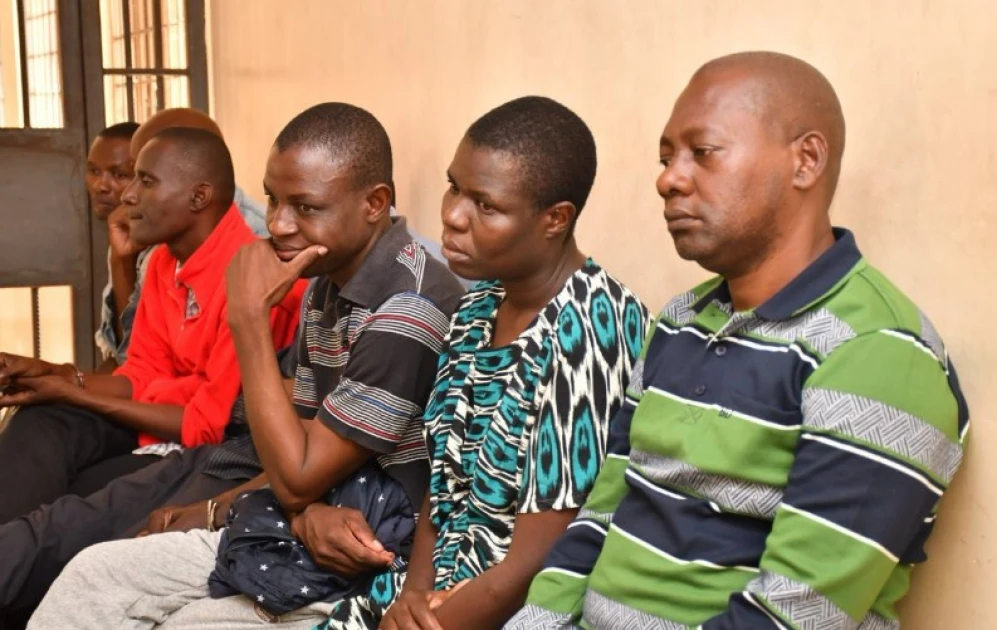
Paul Mackenzie and his co-accused in the Shakahola massacre case appear before the Shanzu Law Courts on August, 6, 2026. PHOTO | COURTESY | ODPP

Audio By Vocalize
In a judgment delivered on Monday, October 19, 2026, the High Court in Malindi found that Mackenzie and his co-accused participated in an organised system of religious radicalisation and enforced fasting that led to the deaths of their followers.
Justice Diana Kavedza ruled that the prosecution had proved its case against all 29 accused persons beyond reasonable doubt, finding them individually and collectively guilty of murder.
The judgment follows a trial in which the prosecution called 120 witnesses while the defence presented nine witnesses, with the court examining events that unfolded in Shakahola Forest, Kilifi County, between January 2021 and September 2023.
According to the court, Mackenzie, who headed the Good News International Ministries (GNI), established an extreme religious belief system that encouraged followers to abandon formal education, reject modern medicine, shun government institutions and isolate themselves from society.
The court identified six pillars of radicalisation, including the denunciation of education and healthcare, rejection of government authority, isolation of followers, relocation to Shakahola Forest and the enforcement of fatal fasting.
Mackenzie was found to have deliberately misinterpreted biblical teachings to convince followers that starving themselves to death would enable them to meet Jesus.
The court heard that the preacher prescribed a sequence in which children were to die first, followed by young people, women, men and finally Mackenzie and his family.
Child survivors testified that they were denied food and water despite supplies being available, while others described watching their siblings die from starvation.
The court also heard that burial ceremonies were referred to as 'harusi', meaning weddings, while deceased followers were celebrated as 'shujaa wa imani', or heroes of faith.
According to the judgment, Mackenzie presided over some of the burials, while graves were flattened and concealed to prevent the discovery of bodies.
Forensic evidence presented during the trial established starvation as the cause of death in 72 cases, while other victims died from asphyxia, manual neck compression and traumatic head injuries.
In 110 cases, the cause of death could not be determined because of advanced decomposition.
However, the court ruled that the circumstances surrounding the deaths, including survivor testimony, the fasting regime and the condition of the graves, supported the conclusion that the victims had also died from starvation.
The court further rejected arguments challenging the reliability of the forensic investigations, finding that the recovery, documentation and examination of the remains had been conducted through a sufficiently organised process.
Justice Kavedza also ruled that children could not legally consent to being starved to death, noting that many had been coerced, beaten, tied up or locked inside houses to prevent them from accessing food or escaping.
The court held that parental responsibility imposed a legal duty to protect children's lives and welfare, rather than giving parents the authority to subject them to fatal religious practices.
"A parent has no legal entitlement to determine that a child should die in pursuit of a religious belief," the court held.
The judgment also established that the fasting regime operated through an organised structure involving religious leaders, village administrators, security personnel, grave diggers and individuals responsible for transporting bodies and concealing deaths.
Among those convicted was Smart Deri Mwakalama, the church's secretary and Mackenzie's second-in-command, whom the court found had transported followers, relayed instructions, apprehended escapees and supervised burials.
Stephen Sanga Muye, identified as the head of security, was found to have participated in assaults, grave digging and the reburial of victims.
Other accused persons were linked to guarding fasting areas, preventing followers from escaping, withholding food and water, and concealing graves.
The court found that Mackenzie had demonstrated direct intention to cause death through his fasting directives, while those who knowingly enforced the regime understood its probable fatal consequences.
It further held that the conduct of the accused satisfied the definition of an extreme belief system under Section 12D of the Prevention of Terrorism Act.
Mackenzie and his associates had pleaded not guilty to 191 counts of murder in 2024.
He also faces separate manslaughter and terrorism charges, to which he has pleaded not guilty.
The Shakahola tragedy came to light in March 2023 after Humphrey Ngono reported concerns about the starvation of two children to Lango Baya Police Station.
The report triggered investigations and a multi-agency operation that uncovered hundreds of shallow graves in Shakahola Forest.
Between April and July 2023, authorities recovered 429 bodies during four phases of exhumation, with 191 victims forming the basis of the murder charges determined in Monday's judgment.
The court heard that followers had abandoned their homes, sold property, resigned from employment, withdrawn children from school and destroyed identification documents before relocating to the forest.
The settlement, which occupied approximately 4,860 acres within Chakama Ranch, was divided into villages bearing biblical names, including Galilaya, Judea, Bethlehem, Sidoni and Samaria.
Mackenzie established the Good News International Church in 2003, with the organisation formally registered in September 2010. It subsequently expanded to approximately 35 branches across Kenya.
He had previously encountered law enforcement, including a 2017 arrest over radicalisation allegations in a case in which he was later acquitted.
The Shakahola tragedy has since sparked widespread debate over religious extremism, accountability and the regulation of religious organisations in Kenya.
Of the original 31 accused persons, two died during the proceedings, while another, Enos Amanya Ngala, pleaded guilty to all 191 murder counts and awaits sentencing.
The remaining 28 accused persons, including Mackenzie, were convicted following the trial and are expected to be sentenced on November 6, 2026.
Join the Discussion
Share your perspective with the Citizen Digital community.
No comments yet
This discussion is waiting for your voice. Be the first to share your thoughts!