
Beneath the bloom: Flower farmers push for safe pesticide waste disposal
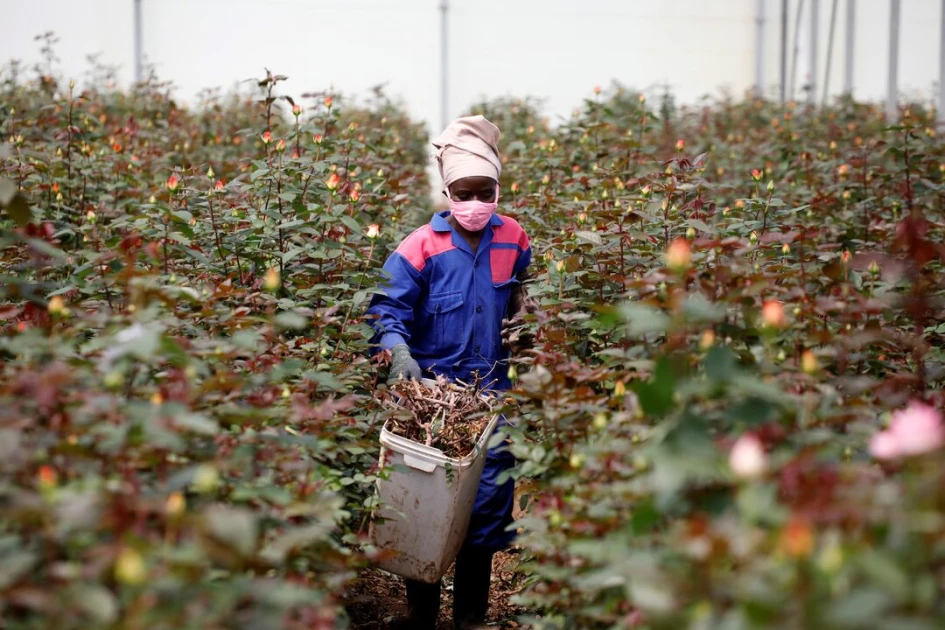
A worker holds roses while wearing protective equipment to help fight against the spread of the coronavirus disease (COVID-19) on the packing line at the Maridadi flower farm in Naivasha, Kenya, July 20, 2020. REUTERS/Baz Ratner

Audio By Vocalize
Kenya is known for producing high-quality roses and a wide variety of cut flowers that are popular in European and other international markets.
These include carnations, lilies, chrysanthemums, and summer flowers, making floriculture a significant contributor to the country’s economy and foreign exchange earnings.
Data from Kenya Flower Council (KFC), shows the sector generated approximately Sh110 billion in export earnings in 2025 and supports more than one million livelihoods across the value chain, including production, packaging, transport and logistics.
Yet, behind the beauty of the blooms lies a growing environmental challenge of managing waste generated during flower production.
The waste includes empty pesticide containers, fertiliser bags, plastic packaging, irrigation materials and other agricultural plastics. If poorly handled, these materials can endanger workers, contaminate soil and water sources, and contribute to plastic pollution.
In the past, flower farmers have shouldered much of the responsibility for managing and disposing of pesticide waste. However, the process has been costly, with fees charged by licensed waste management companies adding to production expenses and squeezing already tight profit margins.
The publication of Kenya’s Extended Producer Responsibility (EPR) Regulations in November 2024 offers growers an opportunity to ease this burden. The regulations require manufacturers and importers to take financial and physical responsibility for their products throughout their life cycle, including the management of waste generated after use.
Under this framework, producers and importers of pesticides, fertilisers and other agricultural products are expected to support the collection, recycling, treatment and safe disposal of packaging waste, reducing the burden previously borne by farmers.
It is for these reasons that aak-GROW and the Kenya Flower Council have entered into a Memorandum of Understanding (MoU) to strengthen responsible pest control product stewardship, environmental sustainability and hazardous waste management in the floriculture industry.
The partnership will help growers adopt responsible practices in selecting, using, handling, storing and disposing of pest control products while strengthening compliance with environmental and waste management requirements.
A key priority is improving the management of empty pesticide containers. The two organisations will work towards establishing designated collection centres and clusters, improving collection and transportation systems, and linking flower farms to licensed waste handlers and treatment facilities.
They will also support the implementation of EPR obligations and promote participation in approved collection schemes coordinated through the Hazardous Waste Producer Responsibility Organisation of Kenya (HAPROK).
Joint training sessions, technical workshops and awareness programmes will build the capacity of flower farms and other stakeholders in pesticide stewardship and environmental management. The collaboration will also extend to smallholder flower growers.
Clement Tulezi of the Kenya Flower Council says the partnership addresses a critical gap in the industry, where effective waste management requires specialised knowledge and coordinated action.
“Kenya’s floriculture industry is committed to continuous improvement in sustainability and responsible production. Working with aak-GROW will help us strengthen the capacity of our members, improve waste management practices and support flower farms in meeting their environmental and stewardship responsibilities,” he said.
The organisations will establish a Joint Coordination Committee to oversee implementation, develop annual work plans and monitor progress. The MoU will also provide a framework for further technical cooperation, advocacy and resource mobilisation.
Tulezi says the industry must demonstrate a collective commitment to sustainability rather than leave individual farms to tackle waste management challenges on their own.
“We do this as a personal responsibility in the first place, but we also focus on our responsibility to the environment, the communities where we operate, our nation, Kenya, and the wider world and markets where we sell, because we are almost 100 per cent export,” he said.
Joel Mutai of aak-GROW says the agreement formalises cooperation that the two organisations had previously undertaken informally.
“We have been working together loosely, not through a signed MoU of this kind. But this is the moment that we put it on paper and we shall be able to sign and move,” he said.
Mutai says sustainability requires shared responsibility among manufacturers, importers, farmers and other players across the agricultural value chain.
“Responsible pest management is not only about the product used, but also about how it is selected, handled, stored and ultimately managed after use. This partnership with KFC gives us an opportunity to strengthen stewardship across the floriculture value chain and support practical solutions for farmers, including better management of empty pesticide containers and compliance with environmental requirements.”
Under the agreement, HAPROK will support the collection and management of waste generated from pest control products and other agricultural inputs used on flower farms.
Andrew Sila, a coordinator at HAPROK, says the organisation is committed to ensuring that empty containers and other agricultural waste are collected for appropriate handling rather than being left to pollute the environment.
“HAPROK is committing to this partnership to ensure that, going forward, we’ll be able to collect empty plastic containers and other waste produced from the inputs used on farms,” he said.
Sila added that farmers will be encouraged to segregate waste at source by separating pesticide packaging from other agricultural waste, making collection and disposal safer and more efficient.
For flower growers, the arrangement could reduce the financial and logistical burden of managing hazardous waste independently.
Join the Discussion
Share your perspective with the Citizen Digital community.
No comments yet
This discussion is waiting for your voice. Be the first to share your thoughts!