
AU-EU joint peace push as Sudan, DRC, Sahel crises dominate talks
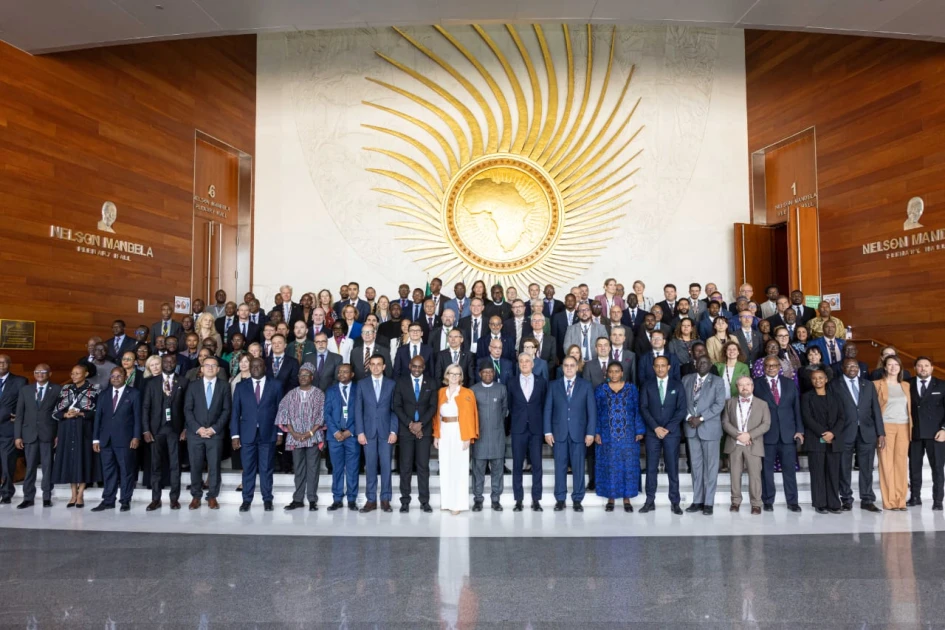
Delegates pose at the 17th Annual Joint Consultative Meeting of the AU Peace and Security Council (PSC) in Addis Ababa. Photo / Courtesy

Audio By Vocalize
The two blocs called for strengthened cooperation, sustained funding for peace operations, protection of civilians and renewed diplomatic initiatives during their 17th Annual Joint Consultative Meeting of the AU Peace and Security Council (PSC) and the EU Political and Security Committee.
The meeting was held in Addis Ababa on November 6, following a joint retreat on November 5 that examined maritime security, counterterrorism, violent extremism, artificial intelligence governance in peace and security, and the Women, Peace and Security agenda.
The meeting was co-chaired by Ambassador Antonin B. Bieke of Côte d’Ivoire, who chairs the AU PSC for November 2026, and Ambassador Lene Mandel Vensild, Permanent Chair of the EU Political and Security Committee.
Among those attending were AU Commissioner for Political Affairs, Peace and Security Bankole Adeoye, AU Special Envoy for Women, Peace and Security Liberata Mulamula, European External Action Service Managing Director for Africa Patricia Llombart Cussac and EU Special Representative for the Great Lakes Region Johan Borgstam.
The two sides reaffirmed their commitment to conflict prevention, management and peaceful resolution, while emphasising the protection of civilians, particularly women and children.
They also called for greater implementation of the Women, Peace and Security and Youth, Peace and Security agendas, noting that sustainable peace requires the full, equal and meaningful participation of women.
The meeting reiterated support for a just, comprehensive and lasting peace in Sudan, eastern DRC, Ukraine and the occupied Palestinian Territory, among other conflict-affected areas.
Somalia and Sudan
On Somalia, the AU and EU commended the Federal Government and the AU Support and Stabilisation Mission in Somalia (AUSSOM), alongside troop- and police-contributing countries, for progress in combating terrorism.
However, they expressed concern over financial and operational challenges threatening the mission’s ability to sustain its achievements and maintain momentum against Al-Shabaab.
They called for predictable and sustainable financing for AU-led peace support operations, including through UN-assessed contributions, implementation of UN Security Council Resolution 2719 (2023), the AU Peace Fund and support from international partners.
They also urged a Somalia-led assessment of the implications of the anticipated drawdown of the United Nations Support Office in Somalia (UNSOS) on the country’s security transition.
On Sudan, the two bodies condemned the devastating impact of the conflict on civilians and public infrastructure, calling for an immediate and unconditional cessation of hostilities.
They stressed that there was no military solution to the conflict and demanded unhindered humanitarian access, a sustainable ceasefire and a return to negotiations, followed by inclusive national dialogue and a civilian-led political transition.
They also condemned external interference, urging foreign actors to stop providing military and financial support to the warring parties. The two sides rejected attempts to establish a parallel government and reaffirmed Sudan’s sovereignty, territorial integrity and national unity.
Eastern DRC, Sahel and Lake Chad Basin
On eastern DRC, the AU and EU expressed concern over insecurity, humanitarian suffering and reported violations of international humanitarian law and human rights by armed groups, including M23.
They condemned sexual violence, recruitment and use of children in armed conflict, calling for perpetrators to be held accountable.
The two blocs demanded an immediate cessation of hostilities, protection of civilians and humanitarian personnel, and safe access for humanitarian assistance. They also endorsed the AU-led mediation process.
They called for full implementation of UN Security Council Resolution 2773 (2025), including the unconditional withdrawal of Rwandan Defence Forces from DRC territory and an end to their support for M23. They equally called on DRC military forces to cease support for armed groups, particularly the FDLR.
The meeting condemned illegal exploitation of natural resources by armed groups and other actors, as well as the establishment of parallel administrations. It called for the dismantling of the M23-backed parallel administration and supported the disarmament, demobilisation, cantonment and repatriation of FDLR elements.
The two sides also emphasised the need for inclusive inter-Congolese dialogue and rejected attempts to overthrow democratically established institutions through force.
In the Sahel, they raised concern over expanding terrorist activities, the proliferation of illicit small arms, climate change and worsening humanitarian conditions.
They called for stronger AU-EU cooperation against terrorism and violent extremism, particularly the exploitation of emerging technologies by terrorist groups to finance and coordinate their activities.
They also urged countries undergoing political transitions following unconstitutional changes of government to pursue nationally owned reforms, inclusive dialogue and the restoration of constitutional governance.
In the Lake Chad Basin, the meeting highlighted continued threats from Boko Haram, Islamic State West Africa Province (ISWAP) and other armed factions.
It raised concern over capability gaps and funding shortages affecting the Multinational Joint Task Force (MNJTF), including shortages of air mobility, amphibious equipment, counter-drone and improvised explosive device capabilities, communications equipment and operational resources.
The AU and EU commended the Lake Chad Basin Commission and MNJTF for their efforts, calling on international partners to increase financial and operational support.
They also welcomed progress under the Regional Strategy for Stabilization, Recovery and Resilience for 2025-2030, supported by the EU, and called for increased investment in humanitarian assistance, economic recovery, climate resilience and sustainable cross-border livelihoods.
The meeting further reaffirmed adherence to international law, the UN Charter, sovereignty and peaceful settlement of disputes.
Both sides committed to strengthening cooperation with the United Nations, regional organisations and other partners, while supporting African-led solutions through the African Peace and Security Architecture and the EU’s Common Security and Defence Policy.
They agreed to hold their 10th Informal Joint Retreat and 18th Annual Joint Consultative Meeting in Brussels in 2027.
The engagement builds on the 7th AU-EU Summit held in Luanda in November 2025, which renewed the two continents’ commitment to cooperation on governance, peace and security.
Join the Discussion
Share your perspective with the Citizen Digital community.
No comments yet
This discussion is waiting for your voice. Be the first to share your thoughts!