
Anglican conservative bloc calls for boycott of Canterbury leadership
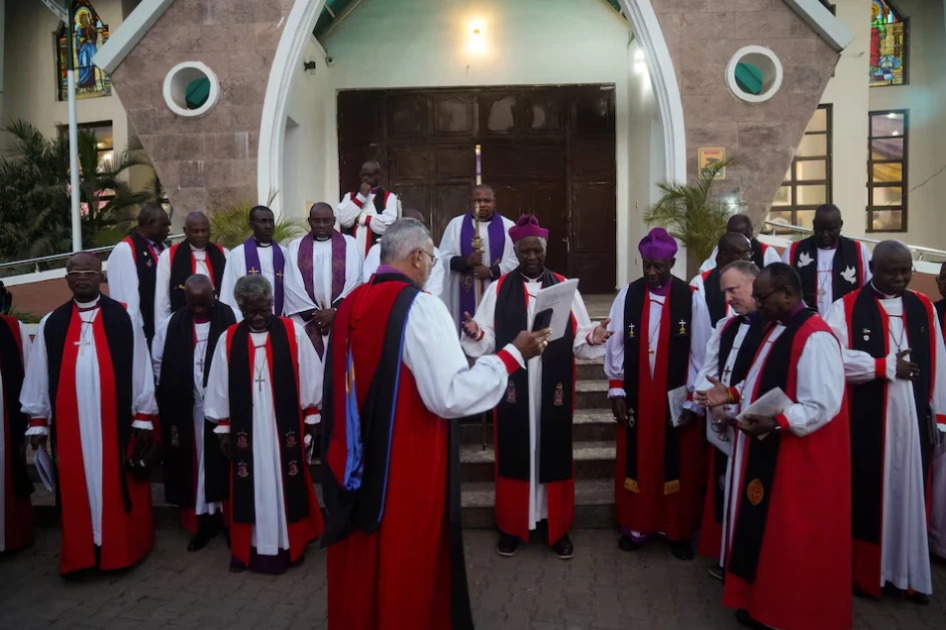
Archbishop Laurent Mbanda of Rwanda, newly elected chairman of the Global Anglican Council, prays with other members after the closing service of the GAFCON G26 council in Abuja, Nigeria, March 6, 2026. REUTERS/Marvellous Durowaiye

Audio By Vocalize
A powerful group of conservative Anglicans on Friday urged
its members to boycott meetings convened by the Archbishop of Canterbury and
halt any financial contributions to the current leadership, escalating a long‑running
rift within the church.
The declaration by the Global Anglican Future Conference
(GAFCON) - a grouping of conservative churches mainly from Africa and Asia that
claims to represent a majority of the world's Anglicans - follows a decision
to establish
a new council rivalling the current leadership.
Three days of meetings of GAFCON members in Nigeria have
underscored the deep rifts within the Anglican Communion over
theological and social issues, including the ordination of women and the
inclusion of LGBTQ+ members.
They come just weeks before the Communion is due to
enthrone Sarah Mullally as its Archbishop of Canterbury, until now spiritual
leader of the world's 85 million Anglicans spread across 165 countries.
Laurent Mbanda, installed on Thursday as chairman of the new
rival council, read a statement saying the Global Anglican Communion required
"a principled disengagement" from structures associated with the
Church of England.
"Leaders who hold office in the Global Anglican
Communion must not attend future Primates' meetings called by the Archbishop
of Canterbury, nor attend the Lambeth Conference, nor attend ACC meetings or
participate in Commissions of the ACC," the statement said.
It added that leaders "should not personally approve
financial contributions to the ACC. It is also expected that they will not
receive financial assistance from compromised sources."
The Church of England did not immediately comment.
'IT'S A SCHISM'
Founded some 500 years ago when the Church of England broke
from Rome, the Anglican Communion has spread to many parts
of the world, particularly former British colonies.
In recent decades, there have been some liberal shifts
within part of the Church. GAFCON was set up in 2008, drawing on the
resistance to these changes, especially in Africa and Asia, where the church
is expanding fastest.
On Thursday, a spokesperson for the Anglican Communion
Office in London said GAFCON was ignoring years of dialogue aimed at reforming
the church.
On whether the church had now split, Diarmaid MacCulloch,
emeritus professor of church history at the University of Oxford, told Reuters: "Of course it's a schism."
But MacCulloch said the rupture need not necessarily be
permanent.
"Schisms do eventually get healed, when both sides see
that the issues that caused the schism don't seem that important any
longer," he said.
RMS Brands






Join the Discussion
Share your perspective with the Citizen Digital community.
No comments yet
This discussion is waiting for your voice. Be the first to share your thoughts!