
Ahmed Haroun's return sparks fears of Muslim Brotherhood comeback in Sudan
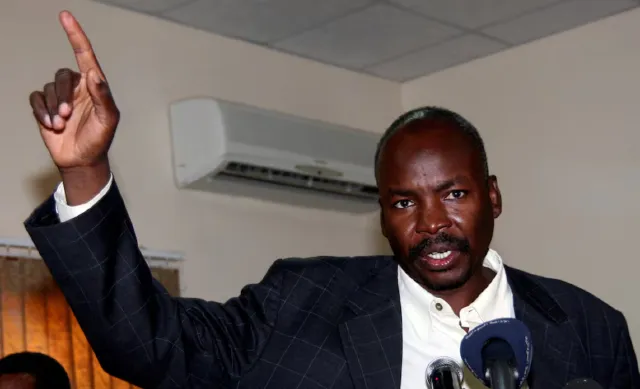
Ahmed Haroun addresses the participants of Civil Administrative Conference during the visit by former Sudan President Omar Hassan al-Bashir to Kadogli capital of South Kordofan State on August 23, 2011 REUTERS/ Stringer/File Photo

Audio By Vocalize
It is a game whose threads have been woven by the Islamic Movement, the Sudanese branch of the Muslim Brotherhood, since the ousting of Omar al-Bashir’s regime in a popular revolution in 2019, in an effort to return to the structures of power and regain influence.
Since the outbreak of the war, the movement has emerged as a key player, obstructing all peace efforts through its entrenchment within the military establishment and its control over army chief Abdel Fattah al-Burhan, who has rejected all initiatives aimed at ending the bloody conflict.
Against the backdrop of shifting military dynamics in Sudan, Ahmed Haroun, head of the dissolved National Congress Party and a wanted fugitive from the International Criminal Court (ICC), has resurfaced in a move that observers have viewed as the beginning of a formal declaration of the Islamic Movement’s positioning and its emergence from the shadows.
Haroun is among those wanted by the ICC on charges of war crimes and crimes against humanity. He was first arrested in April 2019, following al-Bashir’s removal from the presidency in the wake of mass popular protests.
For years, the ICC has sought the surrender of Haroun and al-Bashir. Haroun faces 20 counts of crimes against humanity and 22 counts of war crimes for his role in recruiting militias that perpetrated ethnic massacres in Darfur in the early 2000s. In 2024, the United States offered a reward of up to $5 million for information leading to his arrest.
An Arrest or a Staged Performance?
Haroun’s reappearance sparked widespread public outrage in Sudan, where the wounds inflicted by his crimes have yet to heal. This prompted the authorities in Port Sudan to leak news of his arrest without making an official announcement.
Political analyst Awab Azzam Al-Boushi said Ahmed Haroun sought to convey two fundamental political messages through his media appearance: one directed at army chief Abdel Fattah al-Burhan and the other at the international community.
Al-Boushi explained that “the first message concerns the relationship between the Islamic Movement and al-Burhan. It is that the forces that stood by his side and fought alongside him in the war should not be abandoned under the weight of American and international pressure, nor should he attempt to disavow his partnership with them in the conflict.”
The second message was directed at the international community. “Its substance is that the National Congress Party and the Islamic Movement are very much present in both the political and military arenas, and that al-Burhan represents part of their political equation. This means the organisation does not see itself as a party that can be bypassed or excluded from arrangements concerning Sudan’s future,” Al-Boushi said.
He noted that “the timing of Haroun’s appearance and the nature of the messages conveyed in the interview raise questions about the Islamic Movement’s attempt to move from operating behind the scenes to making its presence public, at a time when international and regional pressure is mounting to remove figures from the former regime from the political landscape.”
Adam Musa Abdullah, head of media affairs at the Popular Struggle Front, said: “The arrest drama was an abrupt and unavoidable reaction to the uproar caused by Haroun’s media appearance and the widespread criticism that followed, particularly among residents of the Darfur region and victims who have been demanding that he be held accountable before the International Criminal Court since 2007.”
The Architect of the Muslim Brotherhood’s Return
Meanwhile, observers believe that this appearance carries serious security-related messages, foremost among them the Islamic Movement’s attempt to formally declare that it is the force controlling the course and fate of Sudan’s war.
A year earlier, Haroun had declared that this would not be the first or last war, suggesting that the man who had been imprisoned was well aware of developments in Sudan and that the war would pave the way for the Islamic Movement’s return to power.
Speaking to Reuters a year ago, he said he expected the army to remain in power after the war, adding that elections could allow his party, the National Congress Party (the former ruling party), and the affiliated Islamic Movement to return to power.
According to Reuters, seven members of the movement, along with six military and government sources, said the army’s recent advances had enabled the Islamic Movement to consider resuming a national role.
He said the movement might support the army remaining in power for an extended period as it looked towards a political comeback, having contributed fighters to the ongoing war in the country.
Speaking to Reuters late at night from an undisclosed location where he was staying out of sight, amid power cuts in northern Sudan, Haroun said the National Congress Party was proposing a governing structure that would give the army control over sovereign affairs, “in view of the threats to Sudanese security and foreign intervention,” while elections would produce a prime minister to run the government.
He added: “The Western model will not be suitable for Sudan. A formula must be reached to define the army’s role in politics amid security fragility and external ambitions. This will not be the country’s first war, nor its last.”
Signs Coming to Pass
More than a year after that interview, Haroun appeared on a media podcast, speaking about the role of the security committee led by former Vice President Awad Ibn Auf and former Director of the National Intelligence and Security Service Salah Abdullah, known as Gosh, in what happened to the ousted regime.
He argued that what took place was not merely the collapse of a ruling regime, but rather the result of betrayal from within the committee tasked with protecting the country.
In the interview, Ahmed Haroun explained that his party, the dissolved National Congress Party, views its relationship with al-Burhan as akin to the relationship between any president and political forces, rather than one based on party or organisational affiliation.
He said the threats facing the state as an entity necessitate moving beyond traditional classifications of government and opposition. He also stated that they harboured no resentment towards the President of the Sovereignty Council, since he had not been a member of the security committee that removed al-Bashir.
In the interview, Haroun put forward the idea of adopting a hybrid political system, questioning whether a model of governance could be developed that accommodates the nature of the relationship between civilian forces and the military establishment.
He proposed an electoral system based on proportional representation, under which each party would receive a share of parliamentary seats commensurate with its electoral weight, rather than a geographical constituency-based system. He also called for political forces to reach a consensus on a new social contract.
A figure who held sensitive positions during a pivotal period in Sudan’s history could hardly make such statements without reference to realities on the ground, coordinated behind the scenes through meticulous planning since the outbreak of the conflict.
Between Haroun’s two appearances, army chief Abdel Fattah al-Burhan had announced the launch of a Sudanese-Sudanese dialogue, an initiative rejected by civilian and political forces, which viewed it as a step towards enabling the Muslim Brotherhood to regain power.
All civilian forces believe that the initiative, in its proposed form, fails to provide the necessary foundations for a genuine peace process. They fear that holding the dialogue in areas under the control of one of the warring parties and under its supervision would entrench the existing state of polarisation and division.
They also consider that launching any political process without first ending the war and addressing the humanitarian crisis would fail to create a conducive environment for comprehensive dialogue. They have warned that the proposed process could become a means of conferring political legitimacy on military rule or bringing forces affiliated with the former regime back into the political landscape.
Join the Discussion
Share your perspective with the Citizen Digital community.
No comments yet
This discussion is waiting for your voice. Be the first to share your thoughts!